Time Series Decomposition
1. The Four Components of Time Series
Any time series can be decomposed into four distinct aspects or groups:
- Secular Trend (\(T_{t}\)): Represents the long-term movement of the series that does not occur within a short time span.
- Seasonal Component (\(S_{t}\)): Refers to regular periodic variations where the cycle repeats after a certain time point (with a period \(\leq\) 1 year).
- Example: Monthly temperature fluctuations (Summer vs. Winter) within a single year.
- Cyclical Component (\(C_{t}\)): Characterized by repetitions where the cycle is longer than one year and occurs at irregular intervals.
- Example: Business cycles involving gradual, long-term upward and downward movements.
- Random/Irregular Component (\(I_{t}\)): Purely random and unpredictable fluctuations.
Note: The Trend, Seasonal, and Cyclical components are considered Systematic Components as they are driven by permanent, predictable causes. The Irregular component is considered an Unsystematic Component or "noise."
2. Case Study: "Nottem" Dataset
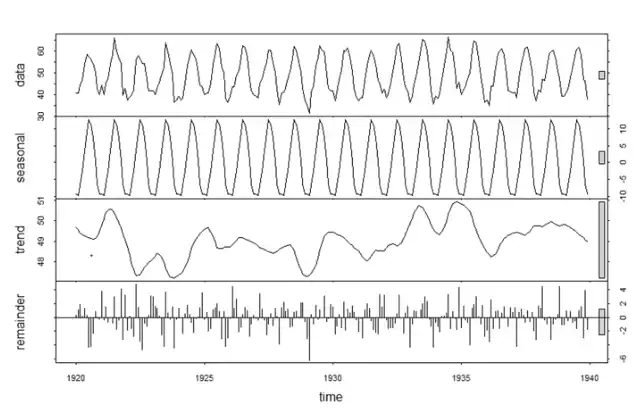
The "Nottem" dataset contains 20 years of monthly temperature data from Nottingham Castle, UK.
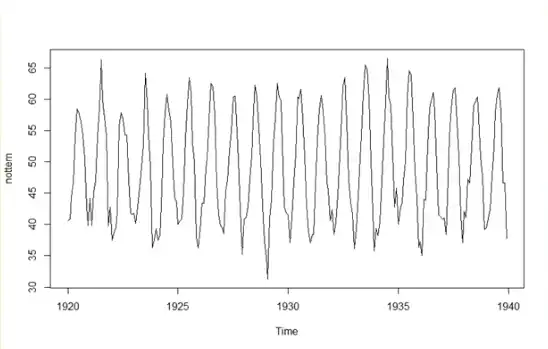
- Observations: The series shows no overall trend, but Seasonality is the dominant feature.
- Remainder: Once the seasonal and trend components are isolated, the "remainder" (\(I_{t}\)) appears completely random, confirming the decomposition logic.
3. Detailed Component Analysis
Secular Trend
- Focuses purely on the upward or downward direction without calendar-related influences or random movements.
- It reflects a change in the average or mean level of the series over time.
Seasonality
- Seasonal Effect: A systematic, calendar-related effect (e.g., higher sales during festive seasons).
- Complex Seasonal Effect: Includes patterns like specific weekly sales or the "number of trading days in a month" effect, which can lead to irregular repetitions.
- Causes: * Natural Conditions: Water consumption in summer or milk production in winter.
- Business/Admin Processes: Increased travel during summer breaks.
- Social/Cultural Behavior: Gold purchases during Dhanteras.
Cyclical Component
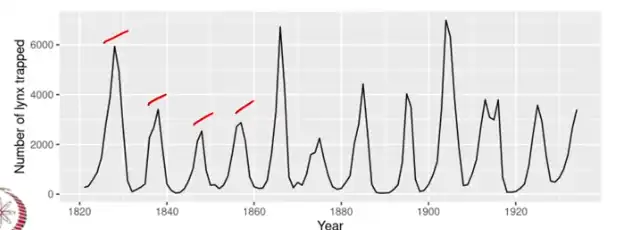
- Visualized as a wave-shaped curve representing expansions and contractions.
- Unlike seasonality, these repetitions are irregular; the peaks are not equal in height and are spaced at irregular intervals.
Irregular Component
- Also known as the residual or random component.
- It is what remains after removing the seasonal and trend components. The differences between its peaks and troughs are completely random.
4. Types of Decomposition Models
The way these components interact determines the type of model used:
| Model Type | Mathematical Formula | Representation |
|---|---|---|
| Additive | \(Y_{t} = T_{t} + S_{t} + C_{t} + I_{t}\) | Represents an absolute amount of change (e.g., producing 10,000 more parts). |
| Multiplicative | \(Y_{t} = T_{t} \times S_{t} \times C_{t} \times I_{t}\) | Represents a relative amount or percentage change (e.g., producing 20% more parts). |