Effective Actuarial Study for Higher Level Exams
Relatable
If you are an (aspiring) actuary. I think you will relate.
I agree everyone's built different and not one size fits all. But I think we more or less face similar problems when studying through our exams. Not everyday do find the motivation to study. We are at our peak motivation just 1 month before the exam but lack time. But 3-4 months before the exam, we have all the time to make the difference but don't have the motivation.
I found out that you don't need to allocate number of hours you need to study and keep track of them to see how well you will do on the exam. That's because its better to keep track of your progress in terms of syllabus and practice problems1.
But, it does help to give you a clear picture of whether you will be able to do justice to the exam. So, just see if you can allot 300-400 hours for the exam in the upcoming months and how much time it would need you per day to get that total hours of work. Think of it as reserving those hours only for your study time so that you don't lax out thinking that you have a lot of time 3 months before the exam. This makes a lot of difference.
The higher level exams (especially after Exam 5) have lots of different papers that you'd need to read and so a good idea is to just speed-run through the papers as an initial pass (maybe within a week or two) and then start doing problems and re-reading the material with more context (developed by practicing problems). That way I feel I get more examples in my head to connect to the theory that I am reading.
Taking Notes
Definitely avoid taking notes thinking that you will refer back to them. Take notes in a way instead that helps your brain take off the load while learning something. As when we write we can offload the brain of some visual memory onto the paper. So, things like complicated formulae can be written and then dissect the formula on the paper or leave your own remarks as to why the formula looks that way. If there are some key points (like assumptions) that you need to write, just write them as small 3-4 worders. Something that only you can read and make sense of.
After going through the entire paper, just see whatever you wrote and try to develop a "High level summary" in your head about what the topic wants to talk about. Definitely don't try to understand something that is very complex at this stage. You can always come back to it later (because if it's going to be tested on the exam, you will have to come back to it in order to answer some questions right and it is then when you enquire for answers that you really understand what the material is trying to say).
One more useful tip is to write a "Study Strategy" note for each paper. For example, after I finished reading the syllabus once, I will start practicing problems from each paper. And when I am almost finishing all the problems, I will have an idea of what the entire paper is trying to tell me. And also things like how I should have approached reading the paper if I was doing it all over again without knowing a thing. And leave a summary like so: See this example:
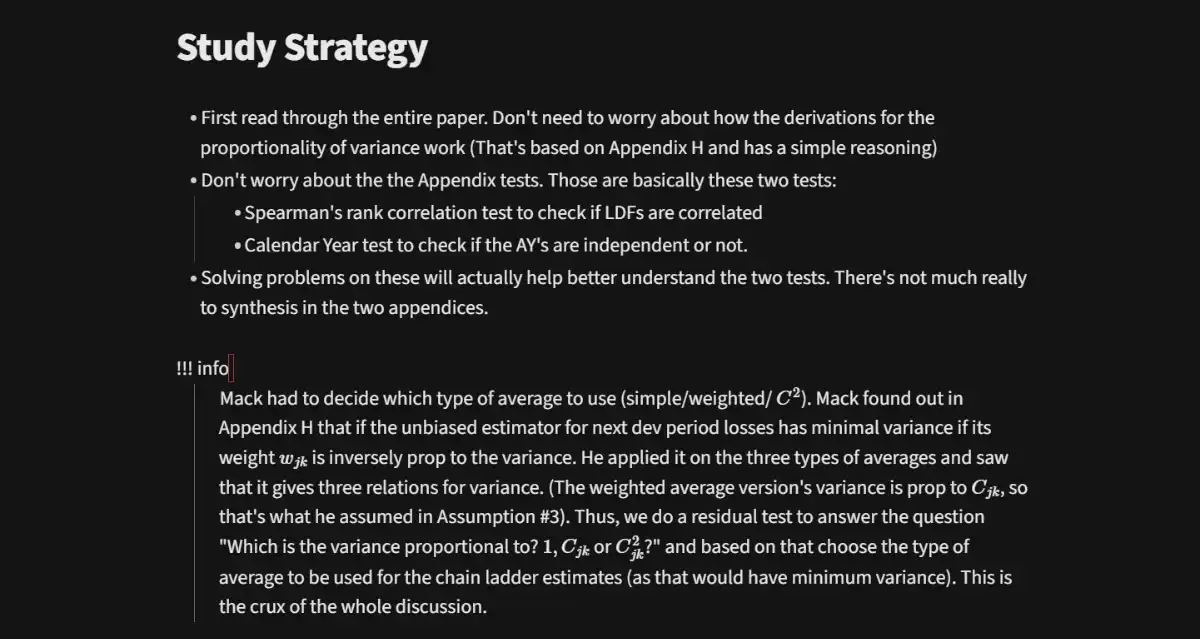
A Demo of the "Study Strategy" note that I wrote for the Mack (1994) paper in Exam 7.
-
Studying for 30 hours sounds good. But studying a single chapter for 30 hours is actually bad (use of time). ↩