Teng & Perkins: Retro Rating & Asset Premiums
Study Strategy
Checklist
- Know the basics of retrospectively rated insurance (the features and benefits)
- Know how to calculate the premium for a retrospectively rated policy
- Be able to calculate the PDLD ratios
- Rating parameter method
- Empirical method
- Be able to calculate CPDLD ratios
- Be able to calculate future expected premium
- Be able to calculate the premium asset
- Be able to explain the basics of Fitzgibbon’s method
- Be able to recognize and explain the graphs of both Fitzgibbon’s method and the PDLD method
- Know the advantages and disadvantages of both Fitzgibbon’s method and the PDLD method
My Notes
- Retro adjustments
- First at 18 months of losses (+9 lag = 27 months of booked premium)
- Subsequent +12 to both (refer to table below)
| Retro adj. | Losses a/o | Booked Prem a/o | |
|---|---|---|---|
| 1 | 18 months | 27 months | Blue |
| 2 | 30 months | 39 months | Yellow |
| 3 | 42 months | 51 months | Green |
| 4 | 56 months | Not yet reflected | N/A |
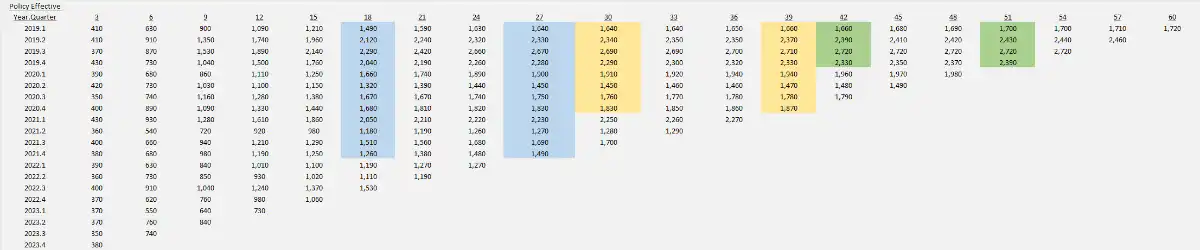
Note that in our calculations, the retro premiums should have reflected in the book. Thus we don't consider 18 month losses from 2022.2, 2022.3 & 2022.4 even though the retro adjustment has already been done. This is due to the lag.
Retrospectively Rated Insurance
After the policy expires → premium is set to reflect actual experience (premium adjusts up or down as losses develop)
- Features
- Even with no losses insured pays minimum premium
- There has to be a maximum premium (else no point of buying insurance)1
- There is a per accident loss limit that caps the amount of individual loss that can contribute to the additional premium being collected
- Benefits
- Good experience \(\implies\) Premium refunds.
- This purchase is attractive for insureds with good loss control and management procedures
- Insurer can attract good consumers this way
- Policyholders benefit by paying premiums gradually (instead of fully up-front). This way, they hold on to cash for longer \(\implies\) possible investment income.
- Insurer benefits → risk due to inflation, rate regulations, increasing claim frequency2, and lawsuits → shift to the insured \(\implies\) improves availability of insurance.
- Good experience \(\implies\) Premium refunds.
Retrospective Premium
- where
- \(CA:\) \(\text{Loss Conversion Factor}\times\text{Capped incurred Loss}\)
- to cover incurred losses (capped at per accident limit) and,
- expense → LAE (represented by \(C\), loss conversion factor), taxes (factor \(T\) multiplied to it) and other state assessments.
- \(b:\) basic premium includes \(= e - (C-1)E[A] + CI\)
- expense provision (company expenses)
- UW
- acquisition
- insurance charge (min and max)
- insured needs protection against large losses \(\implies\) max
- losses \(\gt\) max → insured benefits, insurer loses
- insurer needs to collect enough premium (cover expenses, bit of losses) \(\implies\) min
- losses \(\lt\) min → insurer gains, other loses
- IC \(=E(\text{Loss due to max}) - E(\text{Gain due to min})\)
- insured needs protection against large losses \(\implies\) max
- excess loss charge → accounting for risk of losses exceeding per-accident loss limit.
- expense provision (company expenses)
- \(CA:\) \(\text{Loss Conversion Factor}\times\text{Capped incurred Loss}\)
PDLD Ratio
Disclaimer
These methods are meant to be applied to an entire (or large segment of) book of business, rather than individual policies
Rating Parameter
| Rating Parameter | Name | Description |
|---|---|---|
| \(P_{n}\) | Premium at \(n\)-th retro adjustment | |
| \(BP\) | Basic premium | |
| \(SP\) | Standard Premium | |
| \(\dfrac{BP}{SP}\) | Basic Premium factor | |
| \(L_{n}\) | Total developed at \(n\)-th retro adjustment | |
| \(CL_{n}\) | Capped loss at \(n\)-th adjustment | Any loss contributing to additional premiums |
| \(LCR_{n}\) | \(\dfrac{CL_{n}}{L_{n}}\) = Loss capping ratio (% contributing to additional premium) | - \(\downarrow\) as data matures - If loss data already capped, \(L_{n} = CL_{n}\) and \(LCR_{n}=1\) - Otherwise, the ratio needs to be estimated - LCR = 0.9 \(\implies\) 1-0.9 = 10% of losses are eliminated by max, min and per |
| \(LCF\) | Loss Conversion Factor | loss-related expenses |
| \(TM\) | Tax Multiplier | premium taxes and other state assesments |
which is same as
Deriving this formula makes more sense, just remember the basic identities, and the fact that you have to break \(L_{n}\) and also use \(LCR_{n} = \dfrac{CL_{n}}{L_{n}}\).
There are two parts in this formula:
- \(\left(\dfrac{BP}{SP} \times \dfrac{TM}{ELR \times \%Loss_{1}}\right)\) → Charged even without loss, cost to write and service the policy (unrepeated in subsequent adjustments)
- \([LCR_{1} \times LCF \times TM]\) → cost of the policy for any reported losses (will be adjusted again)
And then,
-
For \(PDLD_{2} = \dfrac{P_{2}-P_{1}}{L_{2}-L_{1}}\)
- Eventually instead of \(LCR_{1}\) write the incremental Loss Capping Ratio, \(\dfrac{CL_{2}-CL_{1}}{L_{2} - L_{1}}\) in the (2) part
-
Pros:
- change to rating params can be accounted for (good for currently written policies)
- PDLDs are more stable than #Empirical method
- Cons
- rating parameters (LDF) cannot be average across segments (to avoid bias)
- thus have to retrospectively test PDLD ratios (actual vs expected)
- rating parameters (LDF) cannot be average across segments (to avoid bias)
Empirical
Don't use ultimate losses because future actual loss development will be accounted for in future premium adjustments.
- Aggregate by Policy effective Quarter3
- Say the first adjustment is done at 18 months, there is a lag in processing and recording adjusted premiums → for them to be booked it will take some more months after the adjustment has been made. (use Lag = 9 months unless stated otherwise)
- So we have to associate losses at 18 months with premiums booked at 27 months.
- Second adjustment is \(\text{Loss date 1} + 12\text{mo} = 30\text{ months}\) → 39 months premiums
- And so on… 42 months loss → 51 months premium, you get the point…
- Reasons for PDLD trending higher
- Perhaps rating parameters have changed (max or per accident-lim might have increased)
- Improvement in loss experience → larger portion of loss is within the cap \(\implies\) more "premium per dollar of loss"
CPDLD Ratios
Reminder
- What's the goal? → to estimate the premium asset
- Premium asset = \(\sum\text{future adjustments on E(Future losses)}\)
This is the weighted average of all the PDLD ratios weighed by the \(\text{\% reported}\), giving more importance to latest PDLD ratios.
- where \(N\) is the total number of retro adjustments to be made in the future.
Premium Asset Calculation
Tip: Understand the Axes
- Before getting into the calculations, understand the Policy effective triangle well
- For any PQ → The number of months actually show how many retro adjustments they would have had.
- It would make sense if you are not given the full triangle to create a column for maturity of each Policy effective quarter.
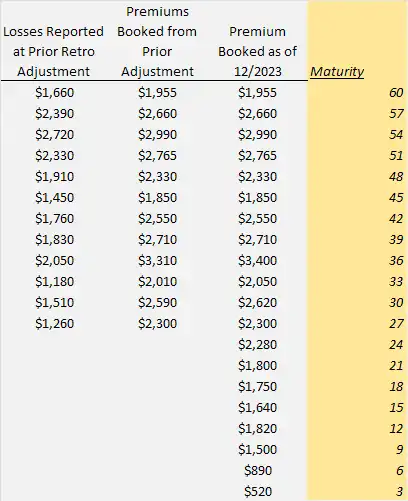
- Notice how at 27 months for premiums, first retro adjustment takes place
- The next at 27 months
- Calculate PDLD and #CPDLD Ratios
- \(E(\text{Future Loss}) =\text{Ult Loss} -\text{Loss a/o most recent retro adj.}\)
- % earned factor for the latest year → to account for the fact that policies aren't fully earned by the end of the year
- If not given, state "I assume that, % earned 100%"
- Most recent retro adj. = prior retro adjustment
- % earned factor for the latest year → to account for the fact that policies aren't fully earned by the end of the year
- \(E(\text{Future Prem}) =CPDLD \times\text{E(Future Losses)}\) ← Corresponding values
- Refer to the top to understand how to map them properly
- Ultimate premium = \(E(\text{Future Prem})+\text{Prem booked a/o most recent retro adj.}\)
- \(\text{Prem Asset} =\text{Ultimate Prem} -\text{Latest Val. Prem}\) ← which is the diagonal prem
Mind the difference between the booked premiums for the ultimate premium calculation
- (4) has a/o most recent retro adjustment
- (5) is what is yet to be adjusted → latest valuation date (diagonal)
Future Premium (step 3) can be calculated in another way
Use \(\downarrow\) formula to find \(P_{3}\), premium at third adjustment
Then find ultimate premium \(P_{ult}\)
And subtract the both: \(E(\text{Future Prem})= P_{ult}- P_{n}\)
Next
- Why not use development method on premiums? Why use PDLD?
- Ultimate incurred loss can be estimated more quickly than retro premiums can be obtained. We get a better estimate sooner.
- LOGICALLY, retro premiums depend on incurred losses → thus look at the connection between them, instead of just premiums
- PROs of PDLD
- Based on rating formula → explainable
- Emphasis on Premium sensitivity (in line with regulatory procedures)
- Adapts to changes in retro parameters (other methods get distorted)
- CON of PDLD
- Ratios are difficult to come by (as params vary by year, state and plan)
Fitzgibbon's method
To calculate premium asset, we use this reserve formula
- \(A\), \(B\) are estimated from historical regression
- \(A:\) intercept → minimum premium to cover expenses of writing and servicing policy
- \(B:\) slope represents the premium responsiveness
- SLR and Retro adjustments from mature PYs (old)
-
\(\implies\) We don't need to calculate plan parameters in the PDLD method
-
CON:
- Doesn't consider emerging loss experience.
- Won't adjust the premium for worse or better loss experience at each premium adjustment.
- Problem 2: SLR doesn't account for the composition of losses (can be one very large loss or multiple smaller losses)
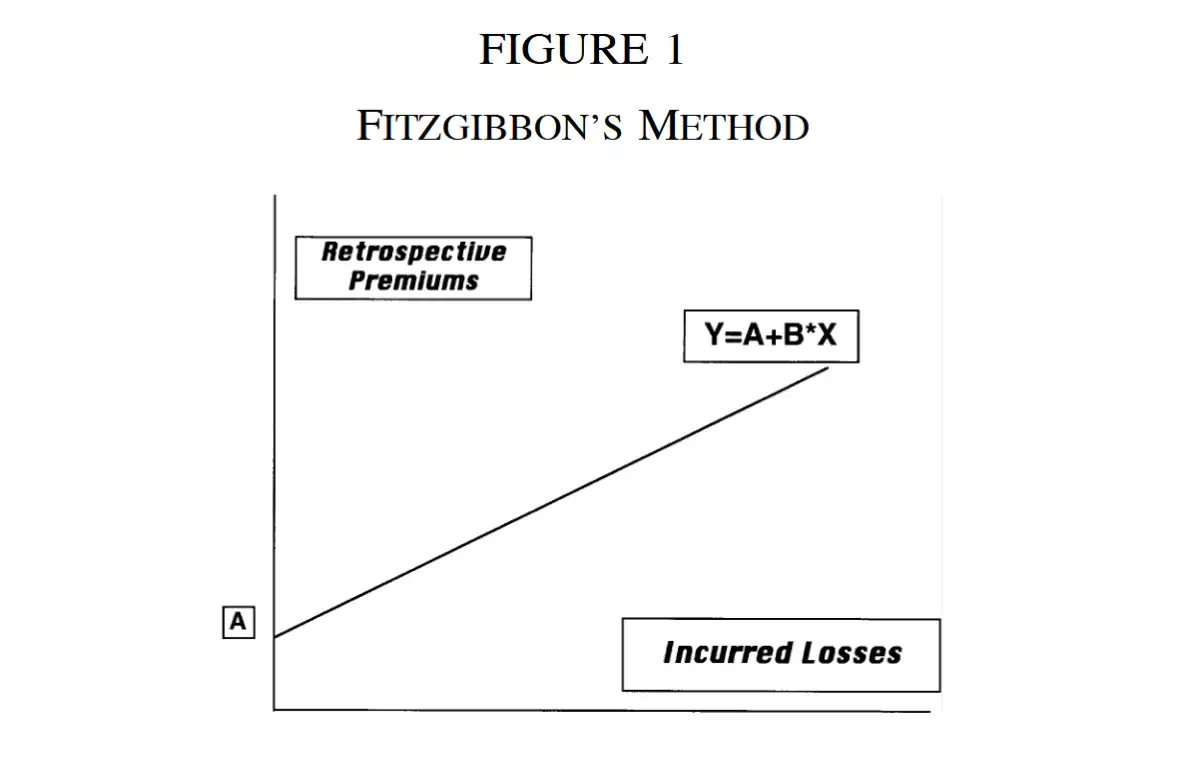
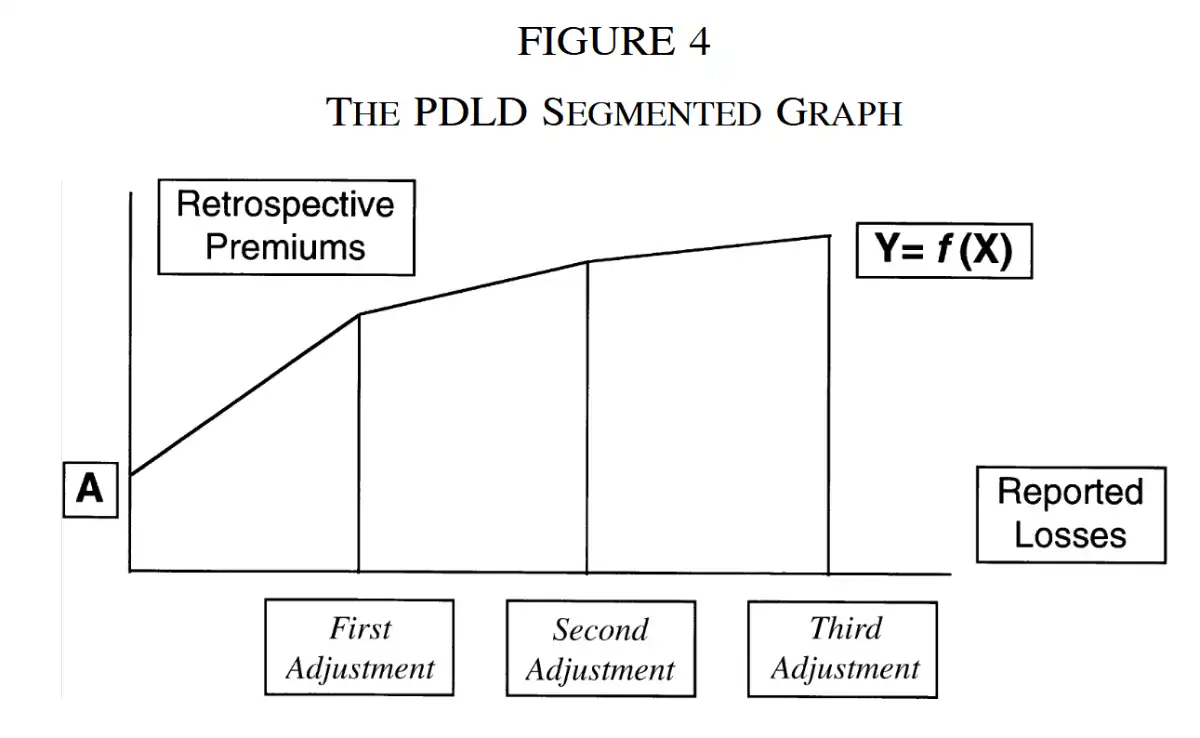
- In contrast, for the PDLD method
- Premium responsiveness declines over time. Why? #later
Muffs
- Be careful when calculating CPDLD ratio… you must divide by the total weights (when finding for \(CPDLD_{2+}\), the \% reported don't add up to 1)