Taylor: GLMs in Reserving
Study Strategy
Checklist
- Know the definition of the exponential dispersion family
- Know the parts of an EDF, their names and purposes
- \(b(\theta)\)
- \(a(\phi)\)
- \(c(y, \phi)\)
- \(V(\mu)\)
- Know \(b(\theta), a(\phi), c(y, \phi),\) and \(\mu\) for the most common EDF members (at least Poisson)
- Know how to get \(E(Y)\) and \(Var(Y)\) for an EDF
- Know the definition of the Tweedie sub-family (including the restriction on \(p\))
- Know the purpose of \(p\)
- Know \(p\) for common Tweedie distributions
- Be able to list the assumptions required for the following stochastic models to replicate chain ladder and know the results
- Non-parametric Mack
- EDF/ODP Mack
- Cross-classified
- Be able to calculate \(\alpha_k\) and \(\beta_j\) values for the cross-classified model
- Know how to set up a GLM
- Design matrix, \(X\)
- Parameter matrix, \(A\)
- \(h(\cdot)\)
- Required selections
- Be able to describe the difference between categorical and continuous covariates
- Be able to describe the GLM set up for either a parametric Mack model or a cross-classified model
- Be able to calculate deviance (including the loglikelihood for common distributions)
- Be able to calculate standardized Pearson residuals
- Be able to calculate standardized deviance residuals
- Be able to state the advantage of deviance residuals over Pearson residuals
- Be able to state how to make adjustments to the model for the following issues:
- Heteroscedasticity
- Outliers
- Only using recent experience
My Notes
- Origin period: \(k\) reported in period \(j\)
- \(Y_{kj}\) → Incremental \(j-1\) to \(j\)
- \(X_{kj}\) → Cumulative losses
- Experience period = calendar period
- \(f_{kj}= \dfrac{X_{k,j+1}}{X_{kj}}\)
- \(f_{j} = \sum_{k=1}^{K-j}w_{kj}f_{kj}\)
Exponential Dispersion Family
GLMs require a distribution from the EDF, which are of the form:
- \(y\) → Value of observation
- \(\theta\) → Location/Canonical param
- \(\phi\) → Dispersion/Scale param (like variance)
- \(b(\theta)\) → Cumulant function → Shape
- \(\exp(c(y,\phi))\) → normalizing factor, makes PDF integrate to \(1\)
| Distribution | \(b(\theta)\) ← Link function | \(a(\phi)\) | \(c(y,\phi)\) | ||
|---|---|---|---|---|---|
| Normal (loss amt) | \(\dfrac{1}{2}\theta^{2}\) | \(\phi=\sigma^{2}\) | \(-\dfrac{1}{2}[\dfrac{y^{2}}{\phi}+\ln(2\pi \phi)]\) | \(\dfrac{1}{\sigma \sqrt{ 2\pi }}e^{ -1/2\left(\frac{y-\mu}{\sigma}\right)^{2} }\) | |
| Poisson (claim counts) | \(\exp(\theta)\) | \(1\) (bcoz, variance = mean) | \(-\ln(y!)\) | \(\dfrac{\lambda^ke^{ -\lambda }}{k!}\) | KNOW THIS! |
| Binomial (loss amt/Freq) | \(\ln(1+\exp(\theta))\) | \(n^{-1}\) | \(\ln\binom{n}{ny}\) | \(\binom{n}{x}p^x(1-p)^{n-x}\) where | \(y = \dfrac{x}{n}\) and \(\theta = \ln(\dfrac{p}{1-p})\) |
| Gamma (loss amt) | \(-\ln(-\theta)\) | \(v^{-1}\) | \(v\ln(vy)-\ln(y)-\ln(\Gamma v)\) | \(\dfrac{1}{\Gamma(\alpha)\theta ^\alpha}x^{\alpha-1}e^{ -x/\theta }\) | |
| Inverse Gaussian (loss amt) | \(-(-2\theta)^{1/2}\) | \(\phi\) | \(-\dfrac{1}{2}[\ln(2\pi \phi y^3+\dfrac{1}{\phi}y)]\) | \(\sqrt{ \dfrac{\lambda}{2\pi x^3}\exp(-\dfrac{\lambda(x-\mu)^{2}}{2\mu^{2}x}) }\) |
Tweedie Sub-Family
- EDF where \(V(\mu) = \mu^p\) where \(p \notin (0,1)\)
- restrict \(a(\phi)=\phi\)
- \(Var(Y)=\phi \mu^p\), variance is \(\propto\) a power of the mean
| Distribution | \(p\) | \(b(\theta)\) | \(\mu\) |
|---|---|---|---|
| Normal | \(0\) | \(\dfrac{1}{2}\theta^{2}\) | \(\theta\) |
| Over-Dispersed Poisson | \(1\) | \(\exp(\theta)\) | \(\exp(\theta)\) |
| Gamma | \(2\) | \(-\ln(-\theta)\) | \(-\dfrac{1}{\theta}\) |
| Inverse Gaussian | \(3\) | \(-(-2\theta)^{1/2}\) | \(-(-2\theta)^{1/2}\) |
ODP
- \(E(Y)=\lambda\)
- \(Var(Y)=\phi\lambda\)
- Traditional Poisson has \(\phi=1\)
- To be used when we don't have much idea about the distribution
- Has the simplicity of traditional Poisson and flexibility due to \(\phi\)
Stochastic Models Supporting the Chain Ladder Method
Chain Ladder provides the MLE of loss reserves.
Non-parametric Mack Model
- Prior Mack Assumptions with "For each AY, losses form a Markov chain" (Loss in one period only depends only on the losses in the period immediately prior and nothing else)
- LDFs are MVUE (among Linear combinations of LDFs)
Parametric (EDF) Mack Models
We get the EDF Mack Model if we change the OG variance assumption to
\(C_{k+1}\) follows an EDF distribution
EDF Mack Model + Full triangle (\(\#AY = \#\text{Dev Periods}\)) ensures
- MLEs of LDFs = Chain Ladder's LDFs
- MLEs of LDFs are Unbiased
Additionally, if EDF is restricted to ODP (ODP Mack Model)
- OG Chain Ladder LDFs are MVUE
- \(\hat{C}_{j+1}\) and reserve estimates are also MVUEs
Cross-Classified Models
- The incremental losses are independent
- The incremental losses have a distribution belonging to EDF
- \(E[Y_{kj}] = \alpha_{k}\beta_{j}\) where \(Y_{kj}\) is the incremental loss and \(\beta_{j}\gt 0\)
- \(\sum_{j=1}^{J}\beta_{j} = 1\)
- Remove redundancy with \(\beta_{1}=0\) or \(\alpha_{1}=0\)
Basically, we have both row and column parameters here.
If…
- Full triangle
- EDF is restricted to ODP
- \(\phi\) is identical for all cells
Then…
- MLE \(X_{j+1}\) and reserves = Chain Ladder estimates
- If \(X_{j+1}\) and reserves are corrected for bias \(\implies\) MVUEs
- Reserve estimates: ODP Mack = ODP Cross-Classified
Process
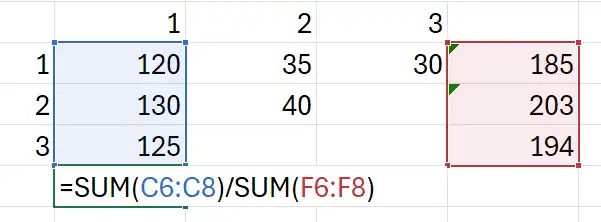
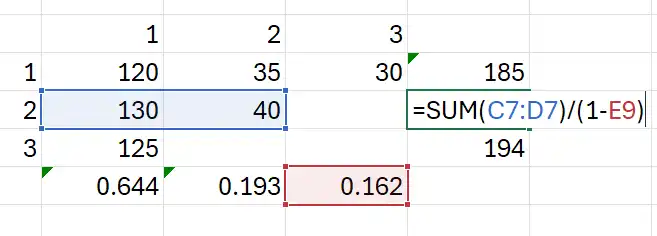
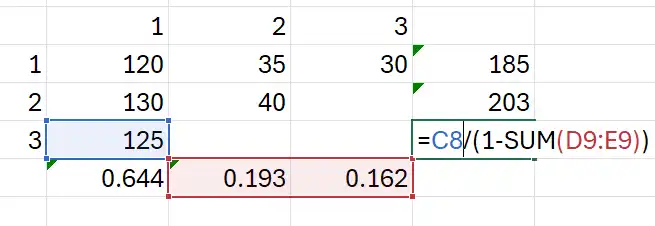
Also, we can calculate LDFs
Generalized Linear Models
- Such1 stochastic models can be represented as GLMs.
- Useful information is returned by statistical software
Thus,
-
\(h(\cdot)\) → Link function
-
Traditional weighted LR model \(\downarrow\)
-
GLM is a generalized version where
- Relation between \(X\) and \(Y\) may be non-linear
- Error terms may be non-normal
-
Params of \(A\) are estimated using MLE
-
\(\phi\) is unknown and usually assumed to be \(\phi_{i} = \dfrac{\phi}{w_{i}}\)
- \(w_{i}\) is a known weight given to each observation
- Required to calculate \(Var(Y) = a(\phi)V(\mu)\)
-
GLM requires
- \(b(\theta)\) → model's assumed error distribution
- \(p\) → mean-variance relation
- Covariates → influencing \(\mu\)
- \(h(\cdot)\) → functional relationship b/w \(\mu\) and covariates
Covariates
- Categorical covariates used in \(X\) (specify which accident year and development year)
- \(\alpha\) → AY
- \(\beta\) → Dev periods
- Continuous variate
- age instead of AY
- linear spline \(L_{mM}(x) = min[M-m, max(0,x-m)]\)
GLM Representations of the Chain Ladder Method
Solve using Chain Ladder
If given characteristics of a GLM model that fit requirements to match the chain ladder output → SOLVE using Chain Ladder, don't setup a GLM.
Parametric Mack Model
- Note that \(\phi_{j}\) doesn't vary by AY
ODP Cross-Classified Model
- Note that \(\phi\) doesn't vary at all
Deviance
- where,
- \(\ell\) represents the log-likelihood function.
- \(\hat{\theta}^{(s)}\) represents saturated parameters
Residuals
Adjustments to the Model
Heteroscedasticity
- Plot of residuals, aren't evenly spaced
- Use non-constant values for \(\phi\)
- Taylor mentions weighting the scale parameter differently
Outliers
- Use weights (0 → Outlier)
- Ensure we are not removing events that reflect potential future variability
Using only Recent Experience
- Set weights for observations outside the last \(n\) diagonals to \(0\).
-
For which chain ladder results are MLE ↩