Measuring the Variability of Chain Ladder Reserve Estimates - Mack (1994)
Study Strategy
This paper has a lot of stuff that you have to memorize, but instead of memorizing stuff one by one. I suggest you do it as a whole. Get the context which makes individual components easy to remember.
- The scope of these paper includes:
- Mack's 3 assumptions (Totally 4 since, assumption #1 has two parts), and how to verify them?
- For different variance assumptions, which LDFs \(f_{k}\) to use?
- Calculating variance of chain ladder estimates (TAKE YOUR TIME HERE)
- Follow the checklist. In particular, these are the things you have to do:
- Assumption #1, #1i, #2, #3 have tests. #1i and #2 are methodical and you should practice them with examples to get a hang of it instead of trying to memorize anything. Get into the sheets directly (TWSS).
- Calculating variance involves multiple steps but it is actually pretty easy to do. There is a #Master Table which tells you exactly what all you need to calculate.
- Just finish through all the problems (would take you around 1 day to do, but take your time)
Checklist
- Be able to list the three chain ladder assumptions
- Know the three different variance assumptions, and how to calculate \(f_k\) under each assumption
- Be able to perform the different assumption tests, know if the data passes or fails the test, and know what assumption it’s testing:
- Calendar year effects test
- Regression test
- Spearman’s rank test
- Residual plot test
- Be able to calculate the confidence interval for individual accident years:
- Know why we prefer a lognormal distribution rather than a normal distribution
- Calculate \(\alpha^2\)
- Calculate the standard error of the individual reserves
- Calculate the variance, \(\sigma^2\)
- Be able to calculate an empirical confidence interval
My Notes
Notation
- \(f_{k}:\) age-to-age factors
- \(R_{i}:\) reserves
- \(I:\) # of AYs
- \(I-k\) refers to the number of cells in the columns for \(k\) in an LDF triangle.
Assumptions
- #1: Expected cum losses in the next dev period are proportional to losses to date
- #1i: Development factors are uncorrelated
- #2: Losses in one AY are independent of losses in another AY
- #3: Variance of cumulative losses in next period are proportional to losses reported to date
- \(E(C_{i,k+1}|C_{i1}, \dots, C_{ik}) = C_{ik}f_{k}\)
- \(\implies\) Dev factors \(f_{k-1},f_{k},f_{k+1}\) are uncorrelated
- Assumption doesn't hold if correlated → An unusually low dev factor immediately following an unusually high dev factor
- Accident years are independent.
- Violated by Calendar year effects → major changes in claims handling or case
- \(Var(C_{i,k+1}| C_{i 1},\dots, C_{i k}) = C_{ik} \alpha_{k}^{2}\)
- \(\alpha_{k}^{2}\) = unknown constant
| Variance Assumptions | Dev factor, \(f_{k} =\) | Plain English |
|---|---|---|
| \(Var(C_{i,K+1} \|\cdot)= \alpha_{k}^{2}\) | \(\dfrac{\sum_{i=1}^{I-k}C_{ik}^{2}f_{ik}}{\sum_{i=1}^{I-k}C_{ik}^{2}}\) | Constant variance, weight by \(C^2\) |
| \(Var(C_{i,K+1}\|\cdot) = C_{ik}\alpha^{2}_{k}\) | \(\dfrac{\sum_{i=1}^{I-k}C_{ik}f_{ik}}{\sum_{i=1}^{I-k}C_{ik}}\) | Mack's case, weight by volume |
| \(Var(C_{i,K+1} \|\cdot)= C_{ik}^{2}\alpha_{k}^{2}\) | \(\dfrac{\sum_{i=1}^{I-k}f_{ik}}{I - k}\) | Var prop to \(C^{2}\), simple average |
Tests
The name of the test and the associated (Assumption #) being tested.
Regression Test (#1)
- Plot \(C_{i,k+1}\) against \(C_{ik}\) for every development period \(k\).
- Check if it approximately linear relationship around \(y=f_{k}\).
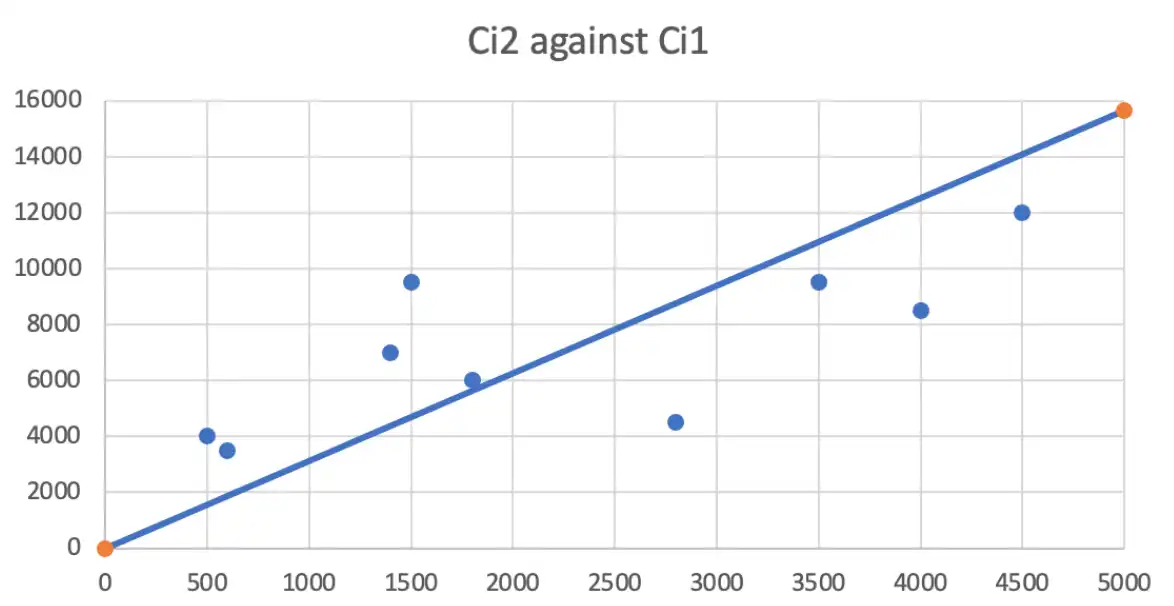
- Underestimate losses less than 2000 and overestimate otherwise
- Mack suggest → Do a regression with an additional intercept parameter
- If all pairings past the test, the dataset passes the test.
Spearman's rank Test (#1i1)
KEYWORD = 'rank', which means we have to the
=rankfunction ;)
- Distribution free test for independence
- Look at triangle as a whole (rather than individual pairs)
Looking at the whole triangle
- Lets us know if correlation prevails globally than in a small part of the triangle.
- Helps avoid an accumulation of error probabilities
Steps
- Calculate LDFs
- Rank the LDFs for each pair of factors
=rank(D1,D1:D3,1)
| \(s_{i 2}\) | \(r_{i 2}\) | \(s_{i 3}\) | \(r_{i 3}\) | |
|---|---|---|---|---|
| \(i=1\) | 2 | 1 | 1 | 2 |
| \(i=2\) | 3 | 2 | 2 | 1 |
| \(i=3\) | 1 | 3 |
- Calculate \((r_{ik}- s_{ik})^{2}\) → sum column \(S_{k}\)
| \(k=2\) | \(k=3\) | |
|---|---|---|
| \(i=1\) | 1 | 1 |
| \(i=2\) | 1 | 1 |
| \(i=3\) | \(2^2=4\) |
- Let \(n\) be the number of Rank-pairs in column
- \(T_{k} = 1 - 6 \dfrac{S_{k}}{n(n^{2}-1)}\)
- \(T\) = Weighted average of \(T_{k}\) with \((\#AY-k-1)\) as weights
| \(k\) | 2 | 3 |
|---|---|---|
| \(T_{k}\) | -0.5 | 1 |
| \(\text{weight}_{k}\) | 2 | 1 |
- \(E(T)= 0\) and \(Var(T) = \dfrac{1}{(\text{\#AY}-2)(\text{\# AY}-3)/2}\)
- C.I. = \(0 \pm z \sqrt{ Var(T) }\)
Calendar Year Effects test (#2)
Reasons for calendar year effects
- Internal
- Strengthening of case reserves
- Changes in claim settlement rates
- External
- Legislative or legal changes
- Greater than average inflation
We fail to prove that there are significant calendar events.
Steps
- Calculate LDFs
- Calculate median
- \(S\) → Smaller than median
- \(*\) → equal to median
- \(L\) → larger than median
- Count \(L\)'s and \(S\)'s in each diagonal
$$
% Triangle Table
\begin{array}{c|cccc}
& j=1 & j=2 & j=3 & j=4 \ \hline
j=1 & L & \bbox[#B4B4FF, 2pt]{S} & \bbox[#FFFFC8, 2pt]{L} & \bbox[#B4F0B4, 2pt]{} \
j=2 & \bbox[#B4B4FF, 2pt]{L} & \bbox[#FFFFC8, 2pt]{} & \bbox[#B4F0B4, 2pt]{S} & \
j=3 & \bbox[#FFFFC8, 2pt]{S} & \bbox[#B4F0B4, 2pt]{L} & & \
j=4 & \bbox[#B4F0B4, 2pt]{S} & & & \
\end{array}
% Summary Table
\begin{array}{c|cc}
j & S_j & L_j \ \hline
2 & \bbox[#B4B4FF, 2pt]{1} & \bbox[#B4B4FF, 2pt]{1} \
3 & \bbox[#FFFFC8, 2pt]{1} & \bbox[#FFFFC8, 2pt]{1} \
4 & \bbox[#B4F0B4, 2pt]{2} & \bbox[#B4F0B4, 2pt]{1} \
\end{array}
$$
- Step 4 (Znm) → "Zanam"
- \(Z_{j} = \min(L_{j},S_{j})\) → Minimum
- \(n_{j} = L_{j}+S_{j}\) → Addition
- \(m_{j} =\text{rounddown}((n-1)/2,0)\)
- \(Z = \sum Z_{j}\)
- Step 5
- \(E(Z_{j})=\dfrac{n}{2}-\binom{n-1}{m}\times \dfrac{n}{2^n}\)
- \(V(Z_{j})=\dfrac{n(n-1)}{4}-\binom{n-1}{m} \dfrac{n(n-1)}{2^n} + E(Z_{j}) - E(Z_{j})^{2}\)
Then do hypothesis testing using this mean and variance. Just check if \(Z=0\) appears in the 95% confidence interval (select \(97.5\)-th percentile since it is a symmetric interval)
Residual Plot Test (#3)
-
Plot the weighted residuals against \(C_{ik}\)
-
(CONSTANT VAR) \(\propto 1\) → wtd. residual = \(C_{i,k+1} - C_{ik}f_{k}\)
- (VAR PROP TO LOSS) \(\propto C_{ik}\) → wtd. residual = \(\dfrac{C_{i,k+1} - C_{ik}f_{k}}{\sqrt{ C_{ik} }}\)
- (VAR PROP TO LOSS\(^{2}\)) \(\propto C_{ik}^{2}\) → wtd. residual = \(\dfrac{C_{i,k+1} - C_{ik}f_{k}}{C_{ik}}\)
Confidence Interval / MSE calculation
| Deviation | ||||
|---|---|---|---|---|
| \((\text{act}-\text{exp})^{2}\) | k = 1 | k = 2 | k = 3 | k = 4 |
| i=1 | 0.000 | 0.003 | 0.000 | 0.000 |
| i=2 | 0.029 | 0.001 | 0.000 | |
| i=3 | 0.003 | 0.002 | ||
| i=4 | 0.003 |
Honestly, \(k=1\) is not required. But may be required for \(\alpha_{k}^{2}\) calculation
Master Table
| k | 1 | 2 | 3 | 4 | 5 |
|---|---|---|---|---|---|
| alpha^2 | 4.46 | 2.24 | 0.00 | 0.00 | |
| alpha^2/f^2 | 2.37 | 1.52 | 0.00 | 0.00 | |
| dev i=4 | 765.00 | 928.79 | 1,123.72 | 1,172.58 | |
| inv sum | 0.00181 | 0.00169 | 0.00176 | 0.00169 | |
| se(R)^2 | 3,777.84 | ||||
| Reserves | 407.58 |
- \(\alpha^{2} = \dfrac{1}{(I-k-1)}\times \sum \prod(C_{k},\text{Deviations})\)
- inv sum = \(\dfrac{1}{\text{Dev}}+ \dfrac{1}{\sum(\text{Col except Diagonal})}\)
- \(se(R)^{2}=\text{Ult}^{2} \sum \prod(\dfrac{\alpha^{2}}{f^{2}},\text{inv sum})\)
Interval Calculation
Since the reserves are following a log-normal distribution, the confidence interval can be found out like so:
- \(\sigma^{2}_{i} = \ln(1+ \dfrac{se(R_{i})^{2}}{R_{i}^{2}})\)
- CI = \(R_{i} \times \exp(-\dfrac{\sigma^{2}_{i}}{2 }\pm z\sigma_{i})\)
Muffs
- Please read the entire question:
- On the top line one assumption was already given
- You were asked in (b) to give the other two. So, naturally you shouldn't state the one that was already mentioned before.
-
Implicit assumption: Development factors are not correlated ↩