Claims-made
Protip
Honestly, you just have to work with many problems related to claims-made to get a hang of it. No amount of reading will help you as much.
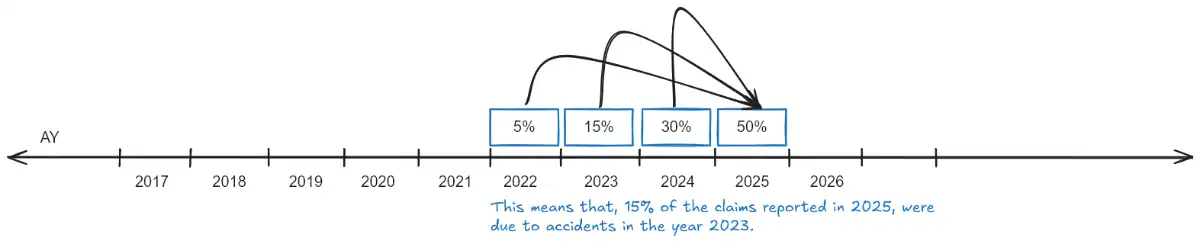
Understanding
- Retroactive date
- Nose coverage
- Tail coverage: Extended reporting endorsement
Gaps in Coverage
- Professional switch: Occurrence \(\to\) CM
- No gap as long as Occurrence expiry = Retroactive date
- Professional switch: CM \(\to\) Occurrence
- Gap since claims occurred in CM will not be covered post expiration.
- So buy tail coverage that overlaps with the Occurrence
- Professional retires:
- Same situation
- Buy tail coverage
Report year organization
You can make Report year development triangles as usual to know development in claims made policies.
- RL = Report Lag
- L(Reported in year, Report Lag)
| RY | RL 1 | RL 2 | RL 3 | RL 4 |
|---|---|---|---|---|
| 2011 | L(2011,0) | L(2011,1) | L(2011, 2) | L(2011,3) |
| 2012 | L(2012,1) | |||
| 2013 | L(2013,2) | |||
| 2014 | L(2014,3) |
- The diagonal will be covered by Occurrence policy for AY2011
- SIMPLE MENTAL MODEL
- Think of a \(L(2012,1)\) as the accident occurred in 2012 - 1 = 2011, and was reported in 2012.
Principles of Claims-Made Pricing
P1: Price of CM vs Occurrence
- Price of claims made policies \(\lt\) occurrence policies, as long as costs are increasing
- More the time till settlement, more the cost of claims
- Occurrence has report lag + settlement lag
- CM has no report lag beyond the expiry of policy1
P2: Unpredictable change in underlying trends
- Occurrence covers claims reported in future years, more time for trends to impact the cost of those claims than for claims-made policies.
- Answer why claims made rates are more accurate and responsive.
- shorter forecast period for trends
- trends are uncertain, applying to shorter periods reduce uncertainty \(\implies\) accurate
- trend selections updated sooner because of shorter forecast period. \(\implies\) responsive
P3: Unexpected shifts in reporting patterns
If there is a sudden unexpected shift in the reporting pattern, cost of a mature claims-made policy will be affected relatively little, if at all, relative to an occurrence policy.
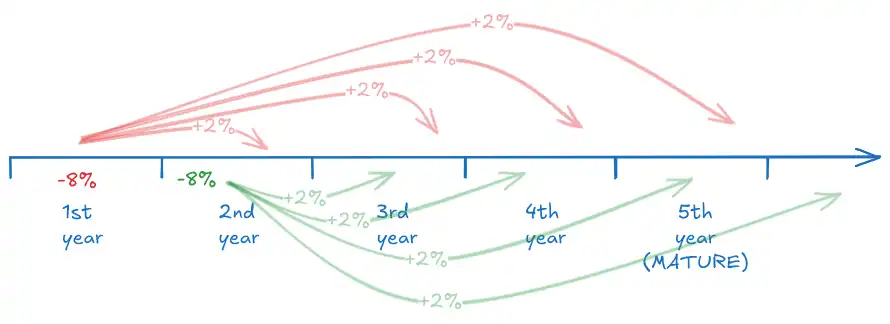
- Assume the reporting pattern changes, 8% less reported from each year
- -8% in the year (say, 1st year)
- 2% of those unreported claims are reported in the next (2nd year) 🤖
- 2% in the year after (3rd year) ⚒️
- 2% (4th year)
- 2% (5th year)
- This distribution is shown by the red lines
- The same happens for the 2nd year,
- -8% distributed in the next years (green lines)
- +2% (from 🤖)
- So net change in reporting in the 2nd year = -6%, not as much as the first year
- The same happens for the 3rd year
- -8% distributed in the next years (as shown in the previous years)
- +2% (from ⚒️ in first year)
- +2% from the 2nd year
- So net change in reporting in the 3rd year = -4%
- Continue with this trend…
- In the 5th year
- -8%
- But +8% from all the previous years…
- net change = 0%
Reiterating it, if there is a sudden unexpected shift in the reporting pattern, cost of a mature claims-made policy will be affected relatively little, if at all, relative to an occurrence policy.
P4: No liability for pure IBNR, risk of reserve inadequacy is reduced greatly
- CM only covered claims reported by the end of the policy term, don't have pure IBNR
P5: Investment income earned in CM is substantially less
compared to occurrence policies
- No report lag beyond the end of the policy term1
- less time than with occurrence policies for the premiums collected to be invested before claims are paid