Section G
Assumptions
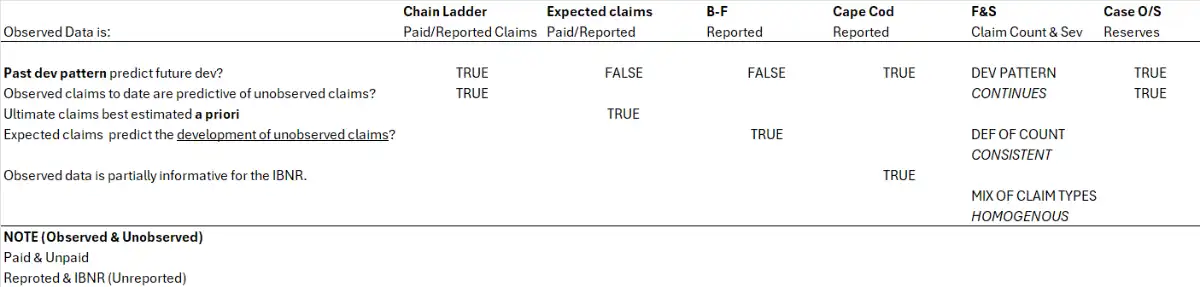
| Technique | Main Assumption(s) | Connection | Other / Secondary Assumptions |
|---|---|---|---|
| Chain Ladder | 1. Past development patterns predict future development. | \(\textbf{Past LDF} \times\text{Latest Claims}\) | Consistent claims processing, stable claim mix, and stable policy/reinsurance limits. |
| 2. Observed claims provide useful information about claims yet to be observed. | \(\text{Past LDF} \times\textbf{Latest Claims}\) | ||
| Expected Claims (EC) | Ultimate claims are best estimated a priori; observed experience to date is not predictive. |
Ult = \(\textbf{ECR} \times \text{Premium}\). We don't use \(\text{Latest Claims}\) |
A reasonable \(\text{ECR}\) is available. |
| Bornhuetter-Ferguson (B-F) | Expected claims, not observed data, predict the development of unreported (IBNR) claims. | IBNR = \(\%\text{unrept} \times\textbf{EC}\), We don't use \(\text{Latest Claims}\) |
A reasonable \(\text{ECR}\) is available. |
| Cape Cod | Unreported (IBNR) claims develop based on expected claims, but observed data is partially informative for the IBNR. | IBNR = \(\%\text{unrept} \times\textbf{CC EC}\), \(\text{CC ECR}= \dfrac{\sum\textbf{Latest Rept}}{\sum \text{Used-up Prem}}\) |
Expected claims are derived from reported claims and earned premium. |
| Frequency-Severity | 1. Past development patterns of claim counts and severities will continue. | Trended Freq \(\times\) Trended Sev | N/A |
| 2. The definition of a claim count is consistent. | Freq won't change abruptly. | ||
| 3. The mix of claim types is homogeneous. | Severity won't change abruptly. | ||
| Disposal rate: Above 3 + Claims are paid in full upon closing (no significant partial payments). | A payment = Claim closed… thus multiply disposal rates to ultimate claims to get "closed claims". | N/A | |
| Case Outstanding Development | 1. Past development patterns predict future development. | LDFs used. | Includes all standard Chain Ladder assumptions. |
| 2. Case outstanding reserves are predictive of future development. | Case O/S |
Practice
- Chain Ladder
- Expected Claims
- Bornhuetter Ferguson
- Cape Cod
- Frequency Severity
Situations
- Increase in Case Reserve Adequacy
- Meaning the case reserves are higher. Apart from the paid claims, those open have a higher reserve allocation. This means that the paid claims triangle will still show normalcy, but the reported claims will be higher for no reason and it would come back to normal in the future
- Increase in Claim Settlement Rates
- Meaning, claims are being settled faster. This \(\implies\) paid portion will increase fast but also implies that the case reserves will deplete faster. The two actions will offset each other and thus, we will see normalcy in the reported claims \(\triangle\). However, the paid claims triangle will see a sudden increase.
- You (just like me in the beginning) might argue that if the paid claims triangle is larger in the beginning, the reported claims triangle should also be. Well, think about two scenarios.
- \(A:\) Case reserve = 1000, Paid claims = 1000 \(\implies\) Rept = 2000
- \(B:\) Case reserve = 200, Paid claims = 1800 \(\implies\) Rept = 2000
- In both scenarios we observe that the reported claims are the same, instead of setting reserves, the claims adjuster is settling the claims faster. Thus the reported amount (based on the actual accident) will remain the same, but owing to the transfer of cash between reserves and paid portion… the paid claims will grow much faster, distorting the paid claims \(\triangle\).