Other Considerations
Regulatory Constraints
- Examples of rate regulation
- Examples of responses by companies
Operational Constraints
- Two examples
- Simple cost-benefit analysis
Marketing Constraints
- Relationship between
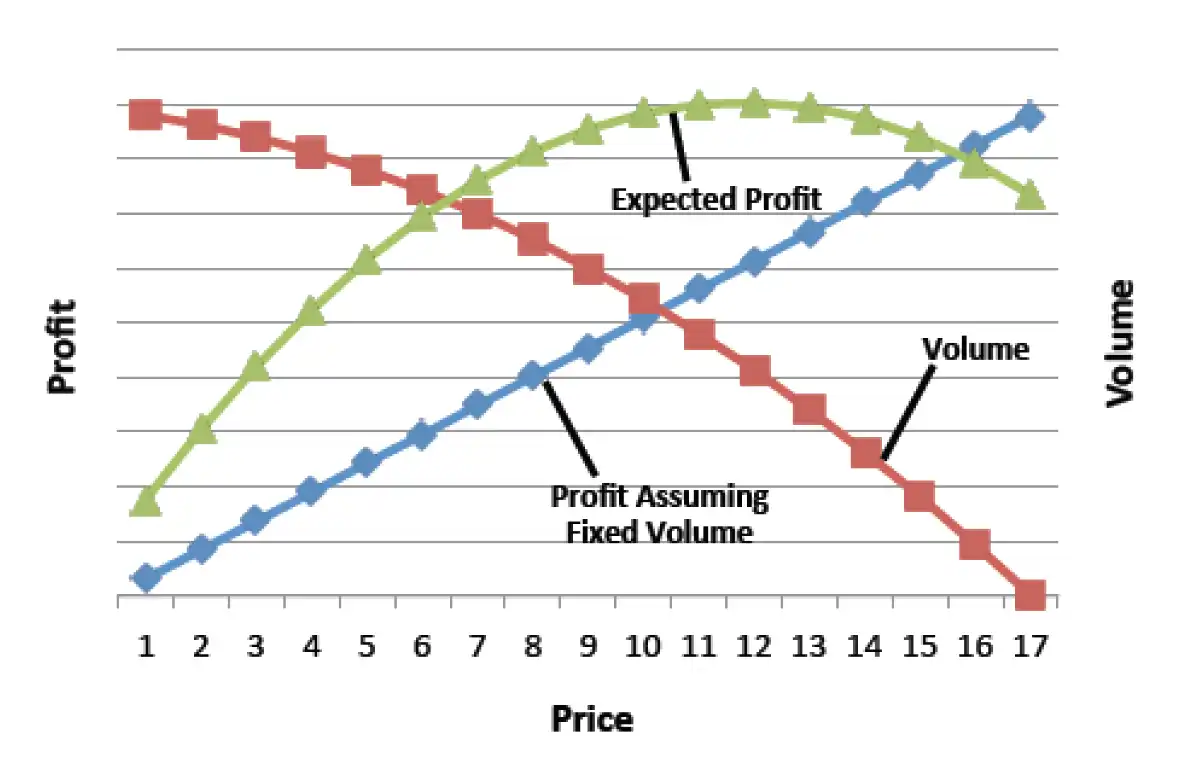
- Blue = Profit based on price charged. For a fixed indicated cost per policy, they are directly proportional (also assuming volume is fixed)
- Red = Volume = # of insureds willing to buy coverage at each price. (Demand is inversely proportional to price)
- Green = Total expected profit, based on profit per policy and # of policies sold
- Factors influencing purchase decision
- Competitor's price
- Overall cost
- For Existing customers, rate changes
- Customer satisfaction & Brand Loyalty
Traditional Techniques for Mark Considerations
I am the insurer. CDPD
- Competitive: my policies, his rates
- Distributional: 30% in state, 10% in book (grow/shrink by segment)
- Policyholder Dislocation: change on retention
- Competitive comparisons
- Obtain competitor rates
- re-rate existing policies with my proposed & competitor's rates
- Analyze if you are cheaper than competitor or certain segments of this market.
- Challenges
- Difficult to get Competitor's rates
- Competitor's UW guidelines unknown
- Distributional analysis
- Identify which segments of book is growing/shrinking with time
- How my market share varies by segment of book
- e.g. if 30% drivers in state are 20-25 aged
- but we have insured only 10% of those drivers
- under-represented in the segment of market
- Policyholder dislocation analysis
- Impact of rate changes on existing customers
- Quantify the distribution of rate changes (% or $ amounts)
- Because customers with large changes are expected to have a lower probability of retention.
- ACTION: Pro-active action, prep the customer for the increase. Try to retain ("You can perhaps increase the deductible to offset the rate increase")
Systematic Techniques
Lifetime Value (renewal probability, long-term profitability)
Optimized Pricing (price elasticity of new vs existing customers)
Insurers try incorporating marketing considerations in pricing decisions directly. E.g. Lifetime Value Analysis (Asset Share Pricing) & Optimized Pricing.
- Lifetime Value Analysis
- Probability of an insured over entire lifetime (assumption about renewal probability)
- Expected Profitability over time
- e.g. Benefit of writing young drivers at a loss in the short-term, and as customers when profitability improves
- Optimized pricing
- Multivariate techniques \(\to\) price elasticity of new & renewal customers based on their characteristics.
- Price elasticity \(\to\) impact of rate change on close ratios & retention ratios.
- New customers are more sensitive to price.
- Existing customers, more friction (effort): shop for insurance and change carriers.
- Test different scenarios of rate changes: how it will impact total profit and growth
Underwriting cycle
"Hard" \(\to\) "Soft" \(\to\) "Hard"
graph LR
        A["
            **Hard Market**
            ---
            *State:*
              - High Prices & Premiums
              - High Insurer Profits
            *Result:*
              - Low Growth (as high prices deter customers)
        "]

        B["
            **Soft Market**
            ---
            *State:*
              - Low Prices & Premiums
              - High Growth (as business is easier to write)
            *Result:*
              - Low or Negative Profits (due to price wars)
        "]

    A --
    "**Action**: Insurers lower rates to gain market share
    Reason: *Attract business with high profit margins*"
    --> B
    B --
    "**Action**: Insurers raise prices & restrict underwriting
    Reason: *Unsustainable low/negative profit levels*"
    --> A

    style A fill:#ffcccc,stroke:#b30000,stroke-width:2px
style B fill:#cceeff,stroke:#005c99,stroke-width:2px- Profit & Growth tends to be cyclical in nature
Arbitrarily starting from the hard market
- A "hard" market:
- prices and profits are high
- High prices so, growth is low
- To attract more business at high profit levels, lower rates.
- Urgently, all insureds lower rates to maintain competitiveness.
- Price competitiveness drives down profits for all insurers, what we call a "soft" market
- Prices are low, growth is high.
- Since profits are low or negative, to increase profitability, restrict writing of business.
- Eventually, all insurers raise prices \(\implies\) "hard" market