Workers Compensation
Total loss ratio = #Medical Loss ratio + #Indemnity Loss ratio + #ALAE
Indemnity
- Indemnity is the portion of Work Comp losses related to lost wages paid to injured employees while they are out of work due to workplace injuries.
- Indemnity loss costs can change due to
- legislative benefit changes (one-time)
- changes in utilization of benefits,
- and inflation.
- The benefit level changes shown here would consider both direct and indirect effects. The -30% was due to a law change. see Workers Comp Benefit Change (SAWW)
Indemnity benefit cost level factors:
| Accident Year | Benefit Level Change | Annual Impact on Benefits due to Wage Inflation | Combined Impact on Benefits | Factor to Adjust Indemnity Benefits to Projected Cost Level |
|---|---|---|---|---|
| 2012 | 0.0% | 1.0% | 1.0% | 0.761 |
| 2013 | 0.0% | 2.0% | 2.0% | 0.746 |
| 2014 | -30.0% | 2.0% | -28.6% | 1.045 |
| 2015 | 0.0% | 1.5% | 1.5% | 1.029 |
| 2016 | 0.0% | 0.9% | 0.9% | 1.020 |
| Projected | 0.0% | 2.0% | 2.0% | 1.000 |
- Combine the impact of level change and inflation, and find the factor that adjusts each year appropriately
- Pay attention to the keyword Annual: Due to which we are doing this on an year-on-year basis.
An alternate representation:
| Accident Year | Avg Benefit Level | Benefit On-Level Factor | Historical Indemnity Loss Trend Factor | Projected Indemnity Loss Trend Factor | Combined On-Level and Loss Trend Factor |
|---|---|---|---|---|---|
| 2012 | 1.000 | 0.700 | 1.066 | 0.761 | |
| 2013 | 1.000 | 0.700 | 1.045 | 0.746 | |
| 2014 | 0.700 | 1.000 | 1.024 | 1.045 | |
| 2015 | 0.700 | 1.000 | 1.009 | 1.029 | |
| 2016 | 0.700 | 1.000 | 1.000 | 1.020 | |
| Projected | 0.700 | 1.020 |
Except for expenses and credibility, all data is Industry data.
Premiums
- Industry loss cost premium
- Already on-leveled for loss cost changes (EoE)
- \(= \text{Hist. Payroll}\times \text{Current Loss Cost} \times \text{Hist. Experience Mod Factors}\)
- (Since we are multiplying the avg E-mod factors, this must be the standard premium)
- On-leveling involves
- Adjusting historical payroll to future level
- Replace hist avg E-mod with \(E(\text{Future Avg E-mod})\)
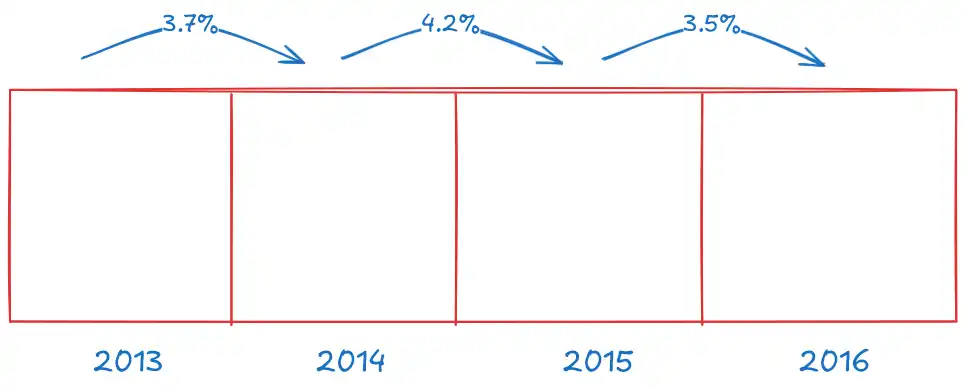
| Accident Year | Industry Loss Cost Premium | Annual Payroll Level Change | Factor to Current Wage Level | Expected Future Wage Level Change | Factor to Adjust to Future Wage Level | Historical Average Experience Modification | Expected Average Experience Modification | Projected Loss Cost Premium |
|---|---|---|---|---|---|---|---|---|
| 2012 | $3,900,972,841 | 2.5% | 1.152 | 6.1% | 1.265 | 0.991 | 0.970 | $4,829,585,462 |
| 2013 | $4,148,612,420 | 3.0% | 1.118 | 6.1% | 1.228 | 0.985 | 0.970 | $5,016,952,524 |
| 2014 | $4,334,300,493 | 3.7% | 1.078 | 6.1% | 1.184 | 0.981 | 0.970 | $5,075,100,094 |
| 2015 | $4,659,789,168 | 4.2% | 1.035 | 6.1% | 1.136 | 0.982 | 0.970 | $5,230,963,178 |
| 2016 | $4,795,461,580 | 3.5% | 1.000 | 6.1% | 1.098 | 0.957 | 0.970 | $5,337,095,962 |
| Total | $21,839,136,502 | $25,489,697,222 |
Medical
- Medical is the portion of Work Comp losses related to medical expenses of injured employees due to workplace injuries.
- Medical loss costs can change due to
- fee schedule changes,
- changes in utilization of medical services,
- and inflation.
- Many medical services are subject to a fee schedule (a pre-determined amount for particular medical services)1
- The annual other medical changes are based on the medical component of the Consumer Price Index, used to measure medical cost inflation.
| Accident Year | Medical Fee Schedule Change | Annual "Other Medical" Level Change | Portion of Medical Losses Subject to Fee Schedules | Combined Effect | Factor to Adjust Medical Benefits to Projected Cost Level |
|---|---|---|---|---|---|
| 2012 | 0% | 2.5% | 75.0% | 0.6% | 0.983 |
| 2013 | 0% | 2.0% | 75.0% | 0.5% | 0.978 |
| 2014 | -20% | 4.0% | 70.0% | -12.8% | 1.122 |
| 2015 | 0% | 4.1% | 70.0% | 1.2% | 1.108 |
| 2016 | 10% | 3.9% | 70.0% | 8.2% | 1.024 |
| Projected | 0% | 8.2% | 70.0% | 2.4% | |
| ## ALAE |
- ALAE ratio is based on Ultimate #Indemnity Losses + Ultimate #Medical Losses
Indication
We first use industry data to find the industry's indication (change to advisory loss costs) for what the rate change should be. Then we adjust it using our company data.
The sheet relates to an individual insurer's rate change in response to the industry loss cost change calculated in the rest of this file.
Total company change is given by
$$
\text{Change to Advisory Loss Costs} \times \dfrac{\text{Proposed Deviation}}{\text{Current Deviation}}
$$
where,
- \(\text{Deviation}= \text{Expense \& Profit Adjustment} \times \text{Operational Adjustment}\)
- \(\text{Operational Adjustment} = (1+\text{Expected Loss Cost Difference})\)
- \(\text{Expense \& Profit Adjustment} = \dfrac{1}{\text{Permissible LR}}\)
- Advisory Loss cost includes
- Indemnity Costs: Payments to injured workers for lost wages.
- Medical Costs: Expenses for medical treatment, rehabilitation, and other related healthcare services
- Loss Adjustment Expenses (LAE): The costs associated with investigating and settling claims
- Advisory LC ratio
- \((\text{Indemnity LR} + \text{Medical LR}) \times(1+LAE)\)
-
Expected loss cost differences: Represents insurer's expectation of how company loss costs will be different compared to industry. e.g. they expect to have 5% lower loss cost than industry, due to better underwriting practices, mix of business etc
-
Deviation a.k.a, Loss cost multiplier, it is a factor of
- Expense & Profit adjustment = 1/(Permissible loss ratio)
- Operational Adjustment = (1+ Expected Loss Cost Difference)
- \(LCM = \dfrac{\text{(1+Expected Loss Cost Difference)}}{\text{Permissible Loss Ratio}}\)
- Multiply this deviation to the loss cost change factor to get indicated change factor
-
Here, we try to find the industry indicated rate change, and adjust it to the company's level.
- The industry's rates will also contain information about expenses and profit, captured in what we call Current Deviation (LCM)
- We have to replace it with our own company's Proposed Deviation (LCM)
-
At its core, a fee schedule dictates the maximum allowable amount for a specific medical service. This predetermined rate is often the result of negotiations between healthcare providers and insurance payers, or it can be set by government agencies for public health programs. It provides standardization that helps in creating a more consistent and predictable healthcare payment system. ↩