TS Decomposition
Time Series Decomposition
Any time series can be decomposed into the following four aspects/groups:
- Secular Trend (\(T_{t}\))
- Long term movement (doesn't happen in a shorter time-span)
- Seasonal Component (\(S_{t}\)), repeats after a certain time-point
- Regular periodic variation (period of cycle \(\leq 1\) year)
- E.g. Summer and Winter (monthly temperature within an year)
- Cyclical Component (\(C_{t}\))
- Repetition cycle is longer than 1 year (and NOT at regular intervals)
- E.g. Business Cycle
- Gradual and relatively long term up and down movements of a series
- Random/irregular Component (\(I_{t}\))
- Purely random and irregular
(1), (2) and (3) are due to permanent causes and are predictable → Systematic Components. (4) is due to "noise" → Unsystematic components.
Example: "Nottem" Dataset
Contains 20 years of monthly temperature in Nottingham Castle (UK)
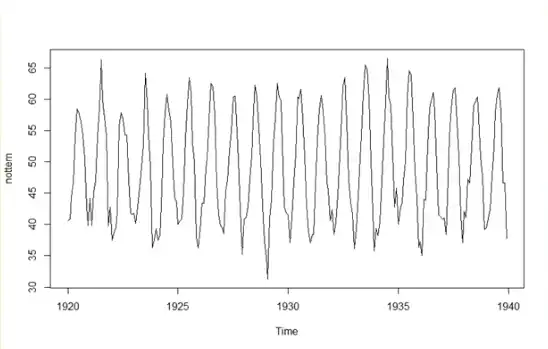
- No trend
- Seasonality is dominant
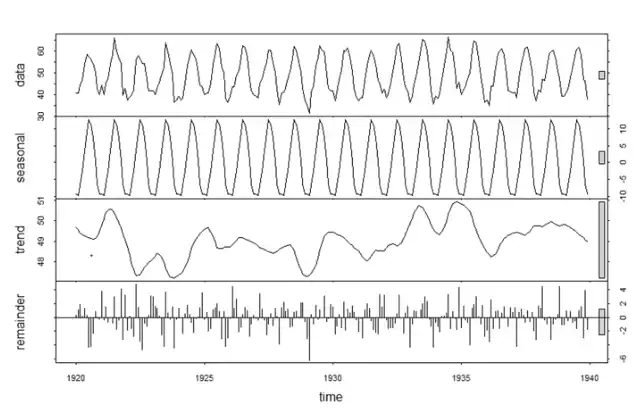
- Remainder is what remains after all others have been isolated, here we see that the remainder is indeed \(I_{t}\) is completely random.
Decomposition: Trend
- Only upward or downward (not upward in summer and downward in winter) → Without calendar related influences
- Without random movement
The average/mean level changes
Decomposition: Seasonality
- Seasonal Effect
- systematic, calendar related effect
- higher sales during festive season
- Complex seasonal effect
- weekly sales of last week
- number of trading days in a month effect (irregular repetitions)
Causes of seasonality
- Natural conditions
- water consumption during summer
- milk production during winter
- Business Admin process
- Higher traveling during summer
- Social/ cultural behavior
- Dhanteras gold purchase
Decomposition: Cyclical component
- Long term variations
- Wave shaped curve (Expansion and contractions)
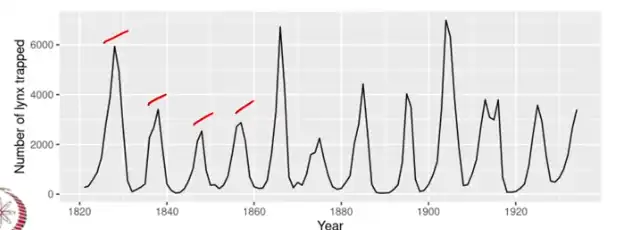
- Repetitions are irregular (peaks are not equal, and spaced irregularly)
Decomposition: Irregular component
- Residual or random component.
- What remains after removing seasonal and trend component.
- Difference between peaks and troughs are completely random
Types of Decomposition
- Additive Decomposition
- \(Y_{t} = T_{t} + S_{t}+C_{t}+I_{t}\)
- Represents an absolute amount. (What is the absolute change?)
- e.g. Manufacturer produces 10,000 more machine parts
- Multiplicative decomposition
- \(Y_{t} = T_{t} \times S_{t} \times C_{t}\times I_{t}\)
- Represents a relative amount. (What is the relative change?)
- e.g. Manufacturer produces 20% more machine parts