Multivariate TS Analysis
Motivation
- Multivariate/Vector processes
- Several related TS processes observed simultaneously over time
- Interested in inter relationships (e.g. \(Y_{t}\) and \(X_{t}\))
- Interested in Cross relationships between the series (\(Y_{t}\) and \(X_{t-2}\) for example)
Objectives
- Understand Dynamic Relationships over time
- Utilize additional information from other time series (\(X_{t}\)) to improve forecasts for \(y_{t}\).
Example
Finance
- Price movements in one market spread easily and instantly to another market.
- E.g. Bitcoin and Ethereum prices
- Consider them jointly to understand the dynamic structure of global market
- For an investor holding multiple assets, making investment decisions
Economics
- Simultaneous behaviors
- Interrelationships between different variables
Environmental sciences and agriculture
- Joint study Min max temperature, humidity, wind speed and direction → Total production of wheat
Health and Environment related studies
- Air pollution level, number of asthma patients, registered cars etc.
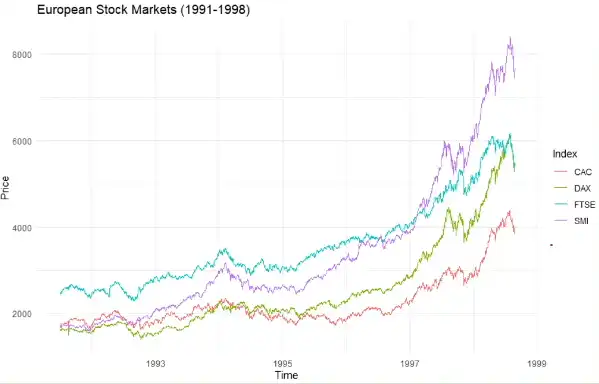
-
We note that there are dependencies between the different indices
-
Another example is Nottem temperatures and "heating demand"
- Another one "population", "employment" etc
Potentially Interesting Question
- Is there a causal direction?
- Are there feedback between the different series?
- How do impulses (shocks) transfer between the series?
- What are the common factors that cause disturbances across series?
Refresher on Matrix Algebra
- \(A\) = \(n \times n\) matrix
- \(f(\lambda) = \lvert A - \lambda I_{n} \rvert\) is a polynomial in \(\{ \lambda_{i} \}\) are the \(n\) roots of \(\lvert A - \lambda I_{n} \rvert =0\)
Thus,
\[
(A - \lambda_{i}I_{n})q_{i} = 0 \quad \text{or} \quad Aq_{i} = \lambda_{i} q_{i}
\]
- \(\lambda_{i}\) are the \(n\) eigenvalues of \(A\)
- \(q_{i}\) are the \(n\) eigenvectors of \(A\). Let \(Q = (q_{1},q_{2},\dots,q_{n})\)
Then,
\[
AQ = (\lambda_{1}q_{1},\lambda_{2}q_{2},\dots,\lambda_{n}q_{n}) = Q\Lambda
\]
Where \(\Lambda = diag(\lambda_{1},\lambda_{2},\dots,\lambda_{n})\)
\[
Q^{-1} A Q = \Lambda
\]
Some properties:
- \(\lvert A \rvert = \Pi \lambda_{i}\)
- \(trace(A) = \sum\lambda_{i}\)
- \(A^m = Q \Lambda^m Q^{-1}\)
Random Vector properties
Let \(X\) be a \(p\times 1\) random vector
- Mean: \(E(X_{i})\)
- Variance: \(E(X_{i}-\mu_{i})^{2}=\sigma_{ii}\)
- Covariance: \(E(X_{i}-\mu_{i})(X_{j}-\mu_{j})=\sigma_{ij}\)