Examples of TS Data
- Why is Time Series important?
- Understand underlying trend and patterns, which helps us to eventually guess how the data will move in the future
- Predict the likelihood of future events (will stock price go up or down?)
- Make inference about the probability models governing series
- Confidence intervals and model parameters
- TS Notation
- \(X_{t},X_{t+h},\dots\) (\(h\) is the time between observations, \(t\) is the time point of the first observation)
- \(\dfrac{1}{h}\) stands for the sampling frequency
- Order is important \(\implies\) Observations are dependent
- e.g.
- \(X_{t}, X_{t+2},\dots\)
- gap = h = 2
- Sampling frequency = 1/2 (half per day)
- Example 1: Carbon-dioxide levels in the atmosphere
- Upward trend
- Repetitions (Seasonality: due to some underlying seasonality)
- Example 2: Oil spot price in dollar/barrel
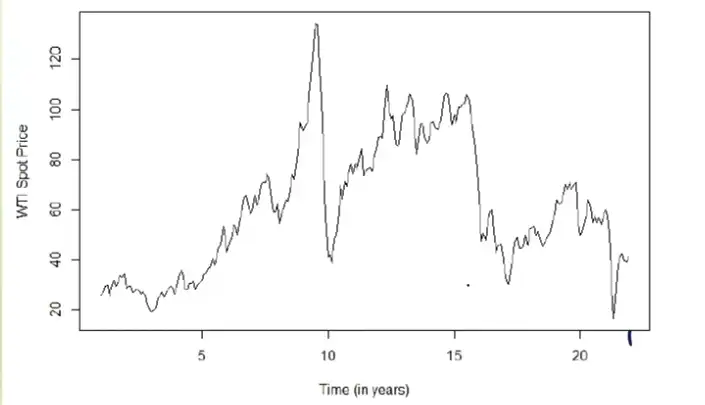
- No overall trend
- No apparent seasonality
- Example 3: SGST (state GST) revenues of India
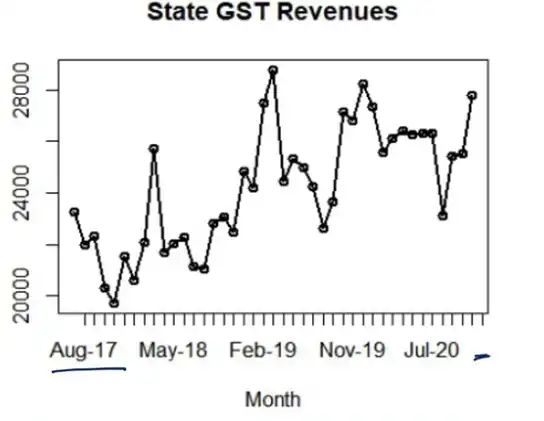
- There is a mild upward trend
- Example 4: Delhi's air quality index between 2017-2020
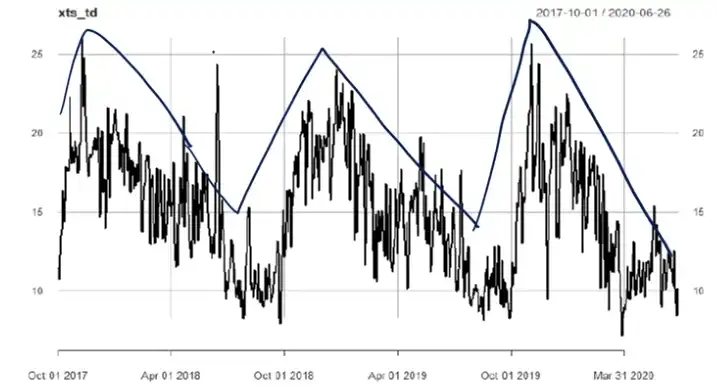
- Mild trend in batches (no overall trend)
- Seasonality is present
- Time scale: Dataset is monthly
-
Example 5: Quarterly sugarcane prices in India
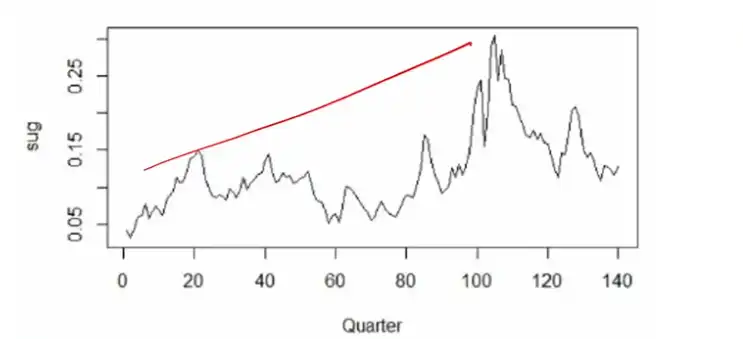
- Time scale: Dataset is quarterly (chosen based on purpose)
-
Choosing Time Scales
- Stock data are available at ticker level
- Consider two things
- scale of required forecasts
- level of noise in data
- Forecast next-day sales:
- Why spend time to collect minute-by-minute data? There will be a lot of noise
- Daily can be used as that's what we need
- Noise = Lot of random repetitions / fluctuations in the data
- Long Vs Short Time Series
- Long = Time series contains a lot of observations
- Weekly interest rates over 5 years
- Daily closing stock prices over 5 years
- Short = Doesn't contain a lot of observations
- Daily closing stock price over a month: 22-23
- Long = Time series contains a lot of observations
- Example 6: Indian Population
- Example 7: Intl. Airline Data (Monthly totals of international passengers)
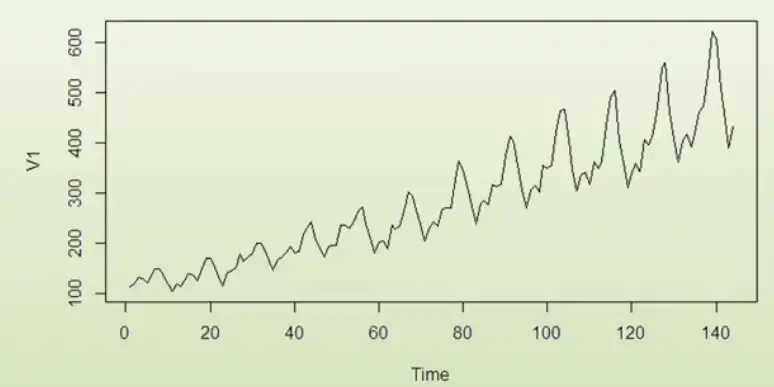
- Non-stationary seasonal time series:
- Upward trend
- Seasonal (low in winter, high in summer)
- Variability increases with time
- Goals of TS analysis
- Explanatory: Understanding the underlying stochastic mechanism that gives rise to new data points
- Predictive: Use that understanding, and the history of the series to predict new values.