Model Identification
How do we find the best possible model (optimal orders \((p,q)\) of the model) given the practical data?
ACF and PACF plots of AR and MA models
| ACF | PACF | |
|---|---|---|
| \(AR(p)\) | Tails off after lag \(p\)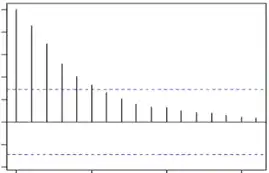 |
Cuts off after lag \(p\)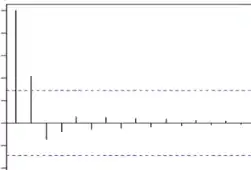 |
| \(MA(q)\) | Cuts off after lag \(q\) |
Tails off after lag \(q\) |
- Note the 95% confidence bands, any correlations outside the band are significant.
- For large and messy data, ACF and PACF become complicated (harder to interpret)
- There can be multiple models. Choose the most appropriate model (with less parameters) → Look at information criteria.1
Information Criteria
- AIC: 1974
- SBC (or BIC): 1978
- HQIC: 1989
Akaike's Information Criteria (AIC)
A statistical model with \(M\) parameters are fitted to data.
\[
AIC = -2\log(\text{Maximum Likelihood}) + 2M
\]
The log-likelihood function becomes
\[
\ln L = -\dfrac{n}{2} \ln 2\pi\sigma_{e}^{2} - \dfrac{1}{2\sigma_{e}^{2}} S(\phi_{p}, \theta_{q}, \mu)
\]
- where
- \(S(\phi_{p}, \theta_{q},\mu)\) is the RSS,
- assuming \(e_{t}\) follows a \(\mathcal{N}(0, \sigma_{e}^{2})\). \(Y_{t}-\hat{Y_{t}} = e_{t}\)
- The first part \(\left(-\dfrac{n}{2}\ln 2\pi\sigma_{e}^{2}\right)\) comes from the normal PDF
\[
AIC = n \log \hat{\sigma_{e}}^{2} + 2M
\]
Schwarz's Bayesian Criteria (SBC) or BIC
A.k.a. Bayesian Information Criteria (BIC)
- BIC introduces an additional penalty term for an extra parameter, to account for the risk of overfitting that comes with higher number of parameters
\[
SBC = n \log \hat{\sigma_{e}}^{2} + M \log n
\]
Hannan-Quinn Information Criteria (HQIC)
\[
HQIC = n \log \hat{\sigma_{e}}^{2} + 2M \log(\log n)
\]
- Due to simplicity people still prefer AIC and SBC.
Other Techniques
- Sample Inverse Autocorrelation Function (SACF)
- Generally captures orders better in seasonal models than PACF
- useful for detecting over-differencing
- Extended Sample Autocorrelation Function (ESACF)
- Can tentatively identify orders of stationary or nonstationary ARMA process
- Based on iterated least squares estimates (previous information criteria were based on MLE)
- Minimum Information Criteria (MINIC)
- Use a combination of AIC and SBC to minimize overall information
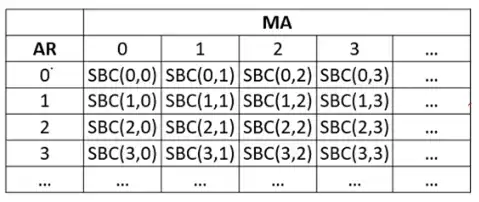
- Which cell gives you the minimum value? Select the orders accordingly.
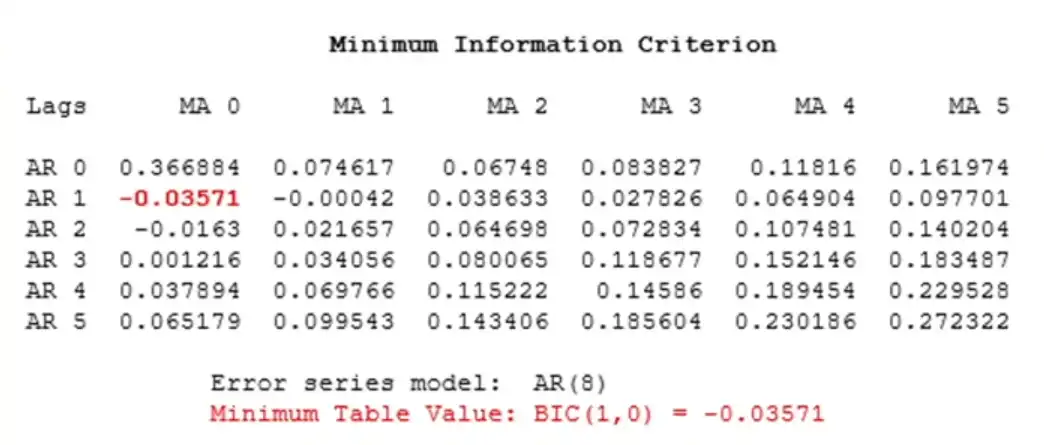
-
If the same job could be done with approximately same accuracy but less number of parameters, prefer that ↩