Seasonality & its Features
-
Note, there is a difference between
- lag \(d\) difference: \(\nabla_{d} Y_{t}\) and,
- \(d\)-th difference: \(\nabla^d Y_{t}\)
- If the trend \(m_{t}\) is a polynomial of order \(d\) then \(\nabla^dY_{t}\) is stationary
- if the data is seasonal with period \(d\) then \(\nabla_{d}Y_{t}\) will remove seasonality.
-
Seasonality
- = regular periodic variation where period of cycle \(\leq 1\)
- usually predictable
- seasonal factors show repeating behavior
- Caused by cycle of seasons, holidays, regular changes in behavior, biological rhythms
-
Examples of seasonality
- Animal migration
- increase in sales
- coffee/warm clothes during winter
- fans/ACs during summer
- clothes and fire crackers' during Diwali
- Unemployment in June
-
Reason to study seasonality
- Better planning for temporal channges
- Eliminate non-stationarity
Graphical Techniques to detect Seasonality
Simple TS or Run Sequence Plot
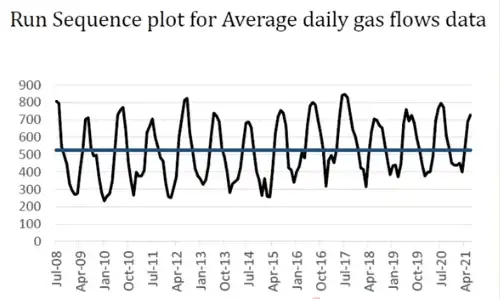
- The mean indicated by horizontal line
- Quarterly data
- Identify
- Seasonality
- Shift in location (local behavior of drifting away from the mean)
- Shift in variation
Seasonal Plot
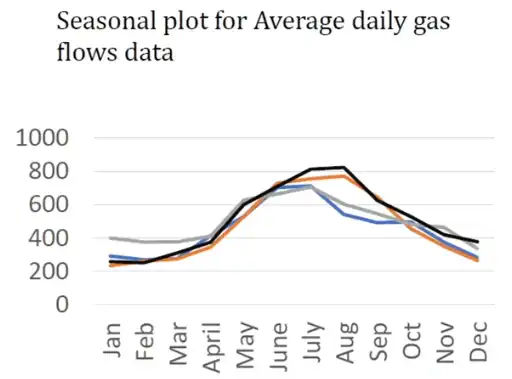
- Each color corresponds to one year
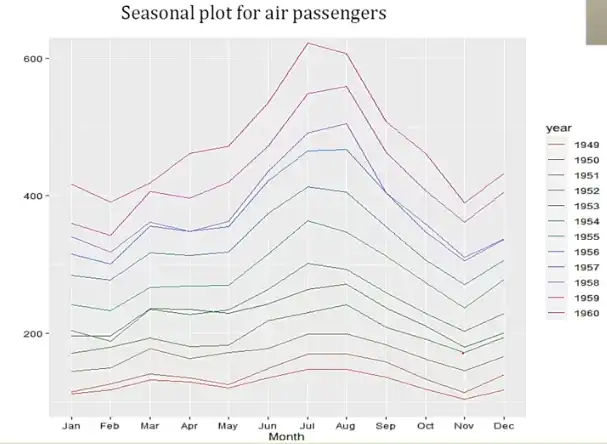
- The graph gives us behavior across years
- Observe
- August (2021 (black) > 2023 (blue))
If we observe the Airline Passengers data
Seasonal Sub-series Plot
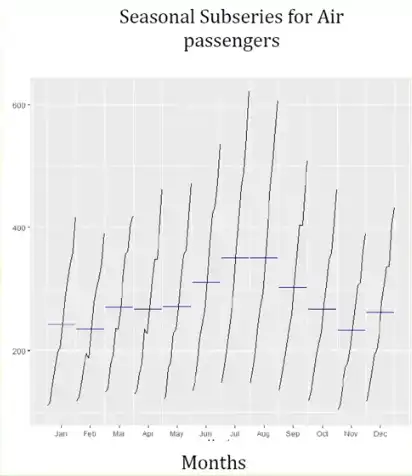
- Evolution over time is more clearer
- Extent: From min to max (the range of values)
- Mean: Blue lines show the mean of the month
- One can't compare the number between two months
Box-plot
Same as #Seasonal Sub-series Plot but also gives the idea of spread by talking about quartiles.