Non-stationary TS
- Trend/seasonality/cyclicality → Non-stationary data which is what is usually expected
- Backshift operator: \(B^dY_{t} = Y_{t-d}\)
- Differencing Operator (Box & Jenkins ka technique): \(\nabla^dY_{t}\) is the \(d\)-th difference of \(Y_t\) for all \(t\).
- \(\nabla Y_{t}=Y_{t}-Y_{t-1}\)
- \(\nabla^2 Y_{t} = \nabla(\nabla Y_{t})=\nabla(Y_{t}-Y_{t-1}) = Y_{t} - 2Y_{t-1} + Y_{t-2}\)
- \(\nabla Y_{t} = (1-B)Y_{t}\)
- lag \(d\) difference: \(\nabla_{d}Y_{t} = Y_{t} - Y_{t-d}\)
Example 1: Linear Trend
\[
Y_{t} = bt + S_{t}
\]
- It is not stationary because mean is time dependent.
\[
\nabla Y_{t} = bt + S_{t} - (b(t-1) + S_{t-1}) = S_{t} + b - S_{t-1}
\]
which is now stationary.
Example 2: Quadratic Trend
\[
Y_{t} = bt^{2} + S_{t}
\]
\[
\nabla Y_{t} = bt^{2} + S_{t} - (b(t-1)^{2} + S_{t-1})
\]
- The trend is strong, one differencing is not enough.
\[
W_{t} = \nabla^{2}Y_{t} = Y_{t} - 2Y_{t-1} + Y_{t-2}
\]
which then eventually becomes
\[
W_{t} = 2b + S_{t} - 2S_{t-1} + S_{t-2}
\]
which is now stationary.
Random Walk Model
\[
Y_{t} = Y_{t-1} + e_{t}
\]
Let's look at it as an \(AR(1)\) model, thus we will get
\[
Y_{t} = c + \phi_{1} Y_{t-1} + e_{t}
\]
- here, \(c=0\) and \(\phi_{1} = 1\)
- But for an \(AR(1)\) process to be stationary, we need \(\phi_{1} < 1\) which is not the case here. Thus, this (random walk) model is non-stationary
Seasonal Models
Classical decomposition model:
\[
Y_{t} = m_{t} + s_{t} + S_{t}
\]
where,
- \(m_{t}:\) trend component
- \(s_{t} :\) seasonal component with period \(d\)
- \(S_{t}:\) stationary process
- Lag \(d\) difference removes seasonality of period \(d\)
- Lag 1 difference (multiple times) remove the trend aspect
\(ARIMA(p,d,q)\) Process
ARIMA if \(W_{t} = \nabla^d Y_{t} = (1-B)^d Y_{t}\), produced by differencing \(Y_{t}\) 'd' times, is a stationary \(ARMA(p,q)\) process.
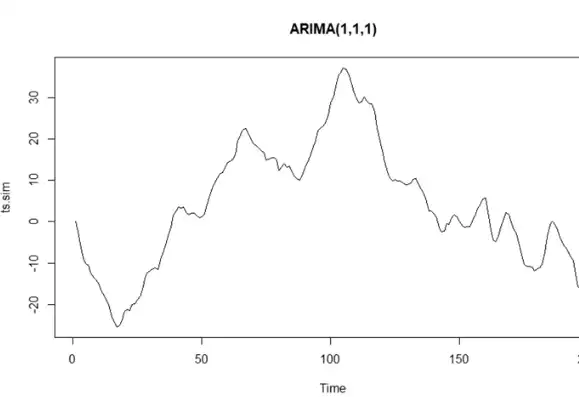
- ARIMA(1,1,1) with \(\phi_{1} = 0.7, \theta_{1} = 0.2\)