Futures Markets & Central Counter Parties
Futures Contracts
- Traded at exchanges
- Specification
- What?
- Where?
- When? (it) can be delivered
-
Settled daily
-
Futures converge to spot

- Margin
- Cash/Marketable security deposited by investor with the broker
- Balance adjusted daily to reflect daily settlement
- to minimize possibility default loss
- Cashflows
- Retail Trader has to bring the balance to initial margin when it falls below maintenance margin level**
- MoE clearing house has to maintain the initial margin in its account everyday (the balance cannot fall below the margin, but can be above it, the surplus can be withdrawn)
- Daily margin cashflows = variation margin
- MoE also requires to contribute to default fund.
Futures Trade Example
Long position in two December gold futures contracts on June 5
- Contract size = 100 oz.
- Futures price US$1750
- Init margin: US $6000/contract (US$12000)
- Maintenance margin: US$4500/contract (US$9000)
- Note
- For each oz., $1750 futures price
- There are 100 oz. in this contract
- There are two futures
- On the first day, the trade price = 1750
- We check the settle price every consecutive day
- The daily gain = 1741 - 1750 per oz. = -$9 per oz.
- 100 oz. \(\implies\) -$900
- 2 contracts \(\implies\) -$1800
- If the margin balance drops below 9000, a margin call is made to replenish to the initial margin (NOT THE maintenance margin)
Margin Cash Flows
When Futures price increases
- Short trader \(\to\) Broker \(\to\) Clearing house member \(\to\) Clearing house
- Clearing house \(\to\) Clearing house member \(\to\) Broker \(\to\) Long trader
When Futures price decreases
- Long trader \(\to\) Broker \(\to\) Clearing house member \(\to\) Clearing house
- Clearing house \(\to\) Clearing house member \(\to\) Broker \(\to\) Short trader
- Price increase, the person who is going to get the asset gets a profit (strike is fixed, price increases… long can buy at a lower (strike) price than the spot price)
- Price decrease, the person who sold the asset gets the advantage (strike is fixed, price decreases… short can sell at a higher (strike) price than the spot price)
Terminology
- Open interest
- total contracts O/S
- # of long positions = # of short positions
- Settlement price
- price just before the final bell each day
- for the daily settlement process
- Volume of trading
- # of trades in one day
Key points about futures
- settled daily
- closing out \(\implies\) offsetting trade
- most contracts closed out before maturity
Delivery
- If futures not closed out before maturity
- settled by delivering underlying asset
- In case of options about what, where & when, the short position chooses.
- Few contracts are settled in cash
- e.g. stock indices & Eurodollars
Types of Orders
Actual operations are referred to market order
Limit
- Order to buy or sell at a specific (or better) price
- Buy limit order is placed below current market price, executes if price drops to or lower.
- Sell limit order is placed above current price, executes only if the prices to or above.
- You get your price (or better) but no guarantee of execution of order.
Stop-loss Order
- Becomes a market order when a specific "stop price" is reached, to limit losses or protect profits.
- sell-stop below the current price on a long position.
- if market price \(\leq\) stop price, trigger sell
- buy-stop above current price on a short position
- Execution guaranteed, but price is not (slippage may occur)
Stop-limit Order
- Hybrid of stop and limit order to give more price control
- STOP Price when hit, becomes a limit order at specified limit - LIMIT Price
- Protects from slippage, but order may not get filled at all.
Market-if-touched (MIT) order
- Becomes market order when price moves in a favorable direction to touch specified price
- Inverse of stop-order
- buy MIT below current price
- hoping to buy on a dip
- sell MIT above current price
- hoping to sell on a rally
- Tool to enter a market at what is more advantageous, can experience slippage
Regulation of Futures
- Primary responsibility of Commodity Futures & Trading Commission (CFTC)
- Try to protect public interest and prevent questionable trading practices
Accounting & Tax
- Ideally, hedging profits should be recognized at the same time as losses on the item being hedged (TIME)
- Ideally, profits and losses from speculation should be recognized on a margin basis (AMOUNT)
Forwards vs Futures
| Forwards | Futures |
|---|---|
| Private contract between 2 parties | Exchange traded |
| Non-standard contract | Standard Contract |
| 1 specified delivery date | Range of delivery date |
| Settled at the end of contract | Settled daily |
| Delivery or final cash settlement usually occurs | Contract usually closed out prior to maturity |
| Some credit risk | Virtually no credit risk |
Foreign Exchange Quotes
- Futures exchange rates quoted as = number of USD per unit of foreign currency
- Forward exchange rates quoted same way as spot exchange rates.
- GBP, EUR, AUD, NZD = \(\dfrac{\text{USD}}{\text{unit of foreign curr.}}\)
- INR, CAD, JYP = \(\dfrac{\text{unit of foreign curr.}}{\text{USD}}\)
Bilateral Clearing vs Central Clearing
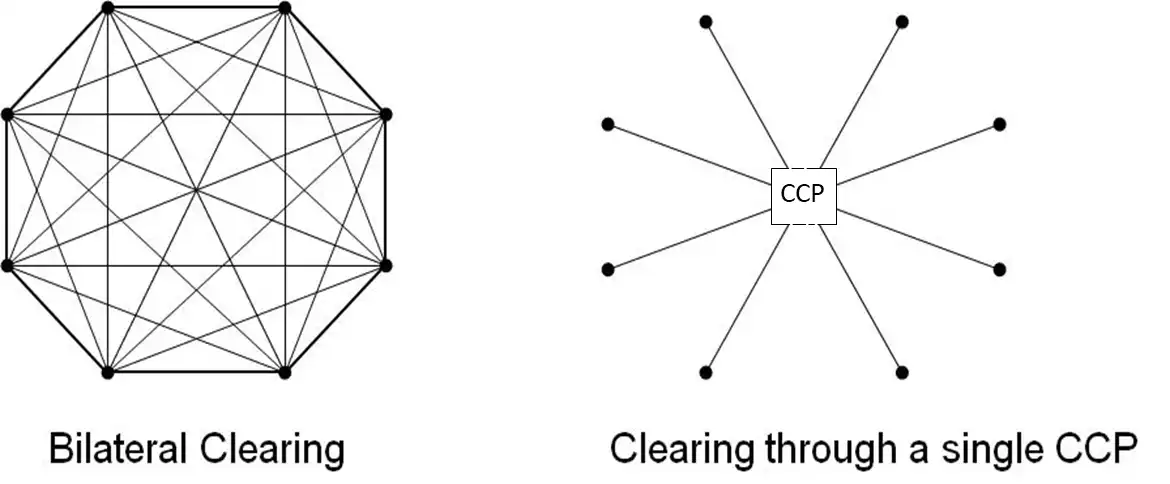
Bilaterally Cleared
- ISDA Master agreement with credit support annex (CSA)