Lecture 55 Centipede Games
- Rosenthal 1981
- Specs
- Two players, alternating moves
- D, A and pass
- Payoff at terminal node
- At each move, take 80% of growing pie and end of the game
- or 'pass' with the pie doubling with each move.
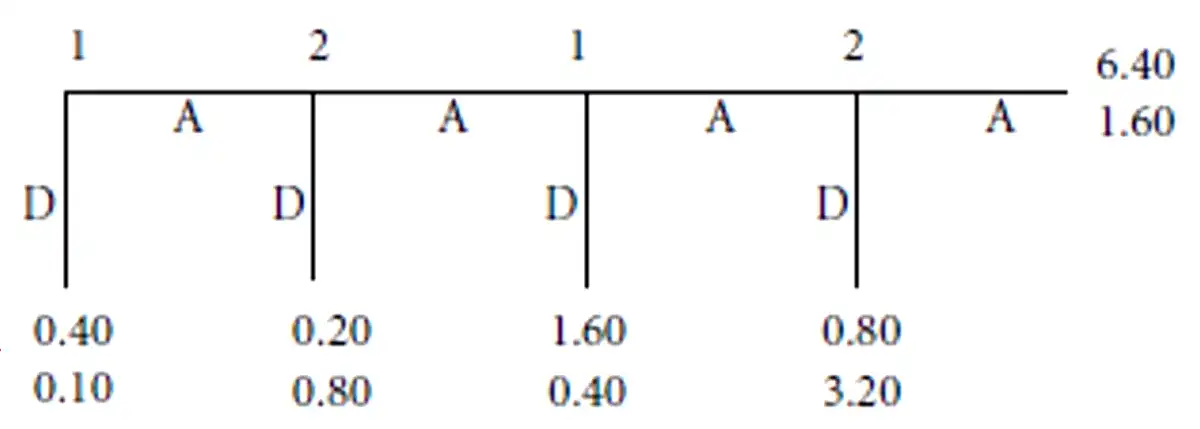
- Unique NE: P1 plays D at the very first game…
- This is a pareto inefficient outcome to choose A at the final node.
Experiments show:
1. Very little evidence of D outcome (Backward induction)
2. \(P(\text{playing D})\) increases as we move closer towards the last node.
3. Evidence appears to be mixed.
Mixed Strategy Nash Equilibrium (MSE): Empirical Failures
Empirical validity of MSE has been questioned.
- Players often deviate from MSE predictions
- Shachat (2002)… people play mixed strategies but mixtures are significantly different.
- Randomization behavior != Classical theory
- Strengthened the case for alternative models (w/ bounded rationality)
Mookerjee & Sopher rejected MSE at individual and aggregate levels.
- Persistent failure of players to converge with MSE on repeated rounds
- Decisions influence with external factors \(\implies\)behaviorally grounded theories required.
Collins & Sherstyuk studied three-firm Hoteling competition model.
Rapoport & Amaldoss investigated R&D investment game with unique MSE
Aggregate level conformity to MSE to some extent. Individuals completely deviated.
Coordination Failures
- Imperfect competition macroeconomic models
- Network externalities and standards
- IT or process or standard is commercially viable if a critical number of users coordinate on adopting it
- Pure strategy payoffs give (200,600) or (600,200). The mixed strategy expected payoff gives 150 per player, which is worse than coordinating on any of the two NEs.
- Empirically, pure strategy NE was played < 42% of the time.
- Widespread coordination failures
Multiple Equilibria
- CGT assumes players will coordinate on an equilibrium… but limited guidance on which equilibrium will emerge.
- Coordination failures \(\implies\) Question predictive power of CGT
Classification of coordination games
- Payoff-Symmetric: Shelling's classic meeting game (relies on focal points for coordination)
- Payoff-Asymmetric: BoS (pre-play communication and timing can influence outcomes)
Median Action Games = Players' payoffs depend on action and the group's median action
- Players failed to converge
- Payoff/Risk dominance couldn't account for observed behavior
- History-dependent (early-round outcomes influenced)
- In absence of communication, players use salient or focal points.
Focal point: Players tend to choose those strategies whose labels are salient. Equilibrium resulting from such choices = focal point.
- Primary salience = actions that are salient for a player
- Secondary salience = coordinating on actions that are believed to have primary salience for other players.
Test for these concepts
- Two groups
- C: Coordinating condition (payoff depends on action of others)
- P: Picking condition (payoff independent of any coordination)
- Group C was relatively more successful at coordinating actions.
- \(c:\) coordination index, a measure of probability that individuals chosen at random will coordinate on their actions
- Distinct choices, \(c=0\)
- Identical choices, \(c=1\)
- Between the two extremes, partial coordination
- \(c:\) coordination index, a measure of probability that individuals chosen at random will coordinate on their actions
Labels convey important information that can help coordinate actions.
- Despite high degree of salience, \(c \lt 60\%\) for the first 10 questions for group C.
There are several factors that influence coordination outcomes, none of which are adequately captured by CGT.
- Outside options and forward induction influences predicted outcomes.
- Framing effects
- Timing of moves
- Pre-play communication
Forward Induction, Timing
- Example of BoS with an addition
- Two phases
- Phase I: P1 can choose between \(X\) and BoS game… where \(X \in(200,600)\)
- Phase 2: BoS game
-
P2 will use forward induction. "If P1 has decided to forgo (200,600) then he is definitely after (600,200)", so he will choose Theatre…
- Thus P2 will coordinate expectations and play "Theatre".
-
But if \(X = 100\), then nothing can be inferred about P1's intentions.
Outside options, framing effects (normal/extensive form) and timing issues influence the level of coordination.