Lecture 54 Problems with Classical Game Theory I
The Challenge of Testing Classical GT
-
Empirical findings: systematic deviations between theoretical expectations and actual human behavior. Assumptions don't hold in practice:
- rationality
- strategic reasoning
- equilibrium selection
-
Why test? To understand how real people behave in strategic situations (vs Econs)
- bounded rationality
- social preferences
- framing effects
- assurance
- resentment
- reciprocity
Enter Behavioral Game Theory.
| Classical prediction | Empirical evidence |
|---|---|
| Players solve by iteratively deleting dominant strategies | Able to engage only a few steps of iterative dominance (higher is rare) |
| Assume that players and the belief that opponents are rational | Are they? |
Suppose \(j\) steps of iterated deletion of dominated strategies.
- \(j=1\), predictions of GT hold
- \(j=2\), majority violate
- Possibility: people have lesser confidence in the rationality of others to engage in IDDS. But there's two problems:
1. If P1 is rational, why does he believe P2 is not?
2. If P2 is believed to be irrational in simple games, then paapam (hardly any games exist where notion of rationality comes)
Suppose a game, 100 people pick a number between 0 to 100. The average of the numbers will be taken, the person with the number closest to 2/3 of the average will be considered winner.
- If everyone picks 100, then the winning number would be 67, no rational player would pick more than 67… but then everyone is rational
- So everyone picks 67… 44…33… all the way down to zero
- NE is zero (0).
But players chose 22 to 33… as they assumed others will not iterate more than 2-3 steps… or didn't play NE strategy even if they know it.
Failure of Two Steps of Iterated Dominance
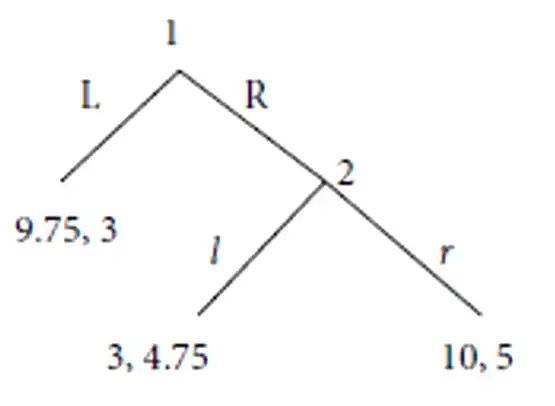
- P1 lacks confidence in the rationality of the opponent and thus would select the \(L\) even though (R,r) would be the NE strategy.
- \(p= 0.97\) (that P2 will play \(r\) if P1 played \(R\))
- But experiment showed \(q = 0.83 \lt 0.97\)
- Thus, the P1 (66%) cannot be called irrational.
There are doubts about mutual rationality.
A Dynamic Game of Perfect Information
- P1 proposes a split of $5.
- If accepted by P2, game ends
- If rejected… the pie size shrinks to $2.
- P2 proposes a split of $2
- If accepted by P1, game ends
-
If rejected… no one gets anything.
-
NE split:
- P1 keeps $3, and P2 gets $2
- Experiments showed:
- P2 kept $2.83 (close to $3) and P2 got $2.17 (thus they accept it)
- But when pie shrank from $5 to $0.5
- P2 kept $3.38 (much lower than $4.5)
- not rational!
Framing Effects
- Normal form: 43\% chose R while extensive form 92\% chose R
Extensive form are frames which makes the dominant strategies more explicit
- Cognitively easier for players to spot dominated strategies.
- Visual structure illustrates sequential moves.
- Only 16% of P1 and 26% of PE chose equilibrium sequence with 3-steps reasons.
- Most player chose the safest (avoiding more steps)
- Games presented through verbal descriptions also altered player's ability to reason through.
Problems
- Players may possess "other-regarding preferences" (relative payoff instead of absolute payoff)
- P2 reject offers perceived as unfair even at a personal cost