Lecture 42 Optimal Consumption in the Two Period Model
The budget constraint with equality can be written as…
called the intertemporal budget line.
Let \(U_{i}\) be a level of utility (constant), then the collection of (\(C_{0},C_{1}\)) such that \(U(C_{0},C_{1}) =U_{i}\) is called the IC.
In economics, because \(U_{0} \lt U_{1} \lt U_{2}\), the shape of IC is convex toward the origin.
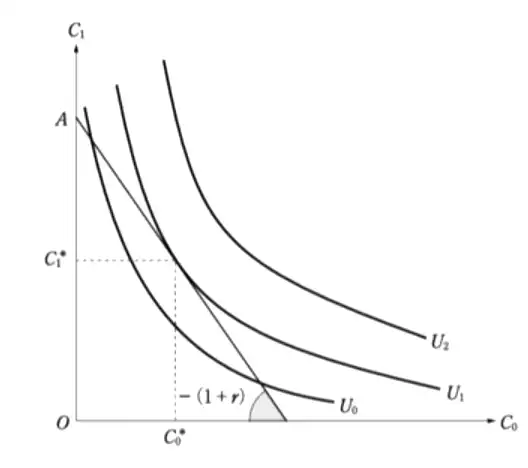
- \((C_{0}^*,C_{1}^*)\) is the combo that maximized utility under budget constraint
- If \(C_{0}^* \lt Y_{0}\), consumer saves the difference
-
If \(C_{0}^* \gt Y_{0}\), consumer borrows the difference
-
IC of a patient consumer = gradual
When present consumption, \(C_{0}\) increases by 1 unit, \(C_{1}\) needs to decrease by a relatively small amount to keep the same utility.
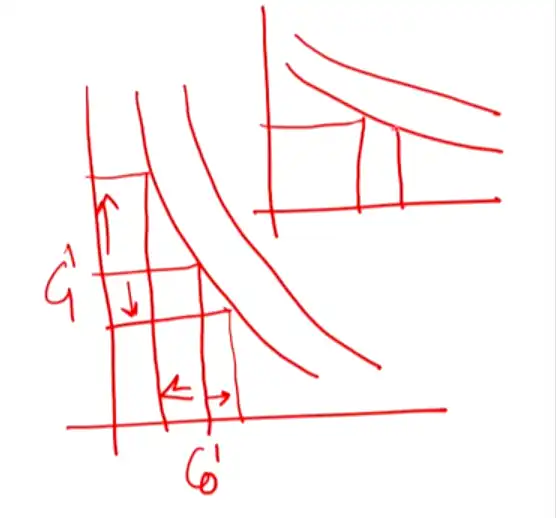
- IC of a impatient consumer = steep
…\(C_{1}\) needs to decrease by a relatively large amount…
Impatient also saves less and borrows more. Thus, slope is important for savings and borrowing decisions.
- Slope of IC is negative, and its absolute value = MRS
$$
=\dfrac{\text{Marginal Utility of Present consumption}}{\text{That of future consumption}}
$$
Thus, MRS = \(\dfrac{\partial U(C_{0},C_{1})/\partial C_{0}}{\partial U(C_{0},C_{1})/\partial C_{1}} =(1+r)\)
Relative price to the intertemporal utility optimization is given by \((1+r)\)
Example of Intertemporal Choice - Adapting to Chronic Kidney Disease
- Living with a dialyzer throughout life is an unpleasant experience.
- When asked about willingness to live… where 1 means indifferent between such life and a healthy life and 0 means indifferent between such life and dying
- Healthy people's average: 0.32
- Current dialysis patients: 0.52
-
One potential reason: the reference scale changed… current patients forgot how good "perfectly healthy" feels like. Thus, their "1" is a healthy person's "0.6".
-
Another study: How would quality of life be after the kidney transplant?
- Who didn't receive transplants… were better off than they predicted
- Who did receive transplants… were worse off…
- They don't really reason it out well!