Lecture 41 Intertemporal Choice Models
Intertemporal Choice
- If costs and benefits occur at different points in time,
- how to make decisions, if there are trade-offs
- Involves resource allocation across different time periods
- saving
- investing
- consuming
\(\implies\) Have long term consequences
Discounted Utility Model (DUM)
- Proposed by Samuelson 1937, how to evaluate decisions
- Though many anomalies observed, this model is widely used.
- John Rae provided psychological foundation for a theory of intertemporal choice (Adam Smith only spoke about importance of ITC)
Origins of DUM
- John Rae and the desire for accumulation. There are four psychological factors that promote/inhibit this desire:
- Promoting
- The bequest motive (descendants)
- The propensity to exercise self-restraint (willpower to sacrifice short-term interests for long-term ones)
- Inhibiting
- Uncertainty of human life (Do we even have a future to save for?)
- The urge for instant gratification (fixate on the immediate object of desire, exciting the attention, rouse all the faculties) We wish to bring our consumption forward.
Two different approaches to time preferencing
- Default situation
- People weigh present and future equally
- Discomfort of delaying makes future outcomes less attractive
- Opposite approach
- People only consider immediate utility
- But anticipation of future utility, may offset any loss of current utility \(\implies\) delayed gratification
According to the approaches (1) & (2)
1. People differ in terms of discomfort they experience
2. According to the difference in abilities to anticipate the future.
Bohm-Bawerk and Tradeoffs
- Austrian #economist
- and later Pagou
People generally underestimate future wants, and thus prefer the present.
- NOTE: This is not related to the discounting, its related to the utility of the outcomes.
- Such intertemporal choices are seen as trade-offs (much like consuming different current goods)
Irving Fisher and IC Analysis
Axes
- \(X:\) Current consumption
- \(Y:\) Future consumption
- MRS concept was applied.
- Depended on time preference
- And DMU
The Two-Period Model's Budget Constraint
- Consumer lives for two periods (0 & 1)
- Labor income \(Y_{0}\) and \(Y_{2}\)
- Consumption \(C_{0}\) and \(C_{1}\). And interest rate \(r\). Utility function \(U(C_{0},C_{1})\)
- Can save, \(S = Y_{0}-C_{0}\)
- If \(C_{0}\gt Y_{0}\), \(S\lt 0\), meaning borrowed money
- Constraint
- \(C_{1}\lt Y_{1} + (1+r)S\)
- meaning, cannot borrow in period 2
Combining both we get
\[
C_{0} + \dfrac{1}{1+r}C_{1}\leq Y_{0}+\dfrac{1}{1+r}Y_{1}
\]
which we call the intertemporal budget constraint. Thus, discounting allows us to compare consumption and income across periods.
- Borrowing and lending allow us to rearrange our capacity to buy/sell across time.
- \(\implies\) buy more now, but constrains later to buy less
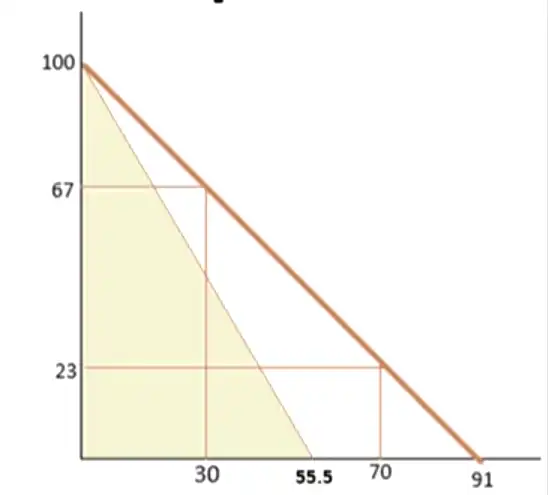
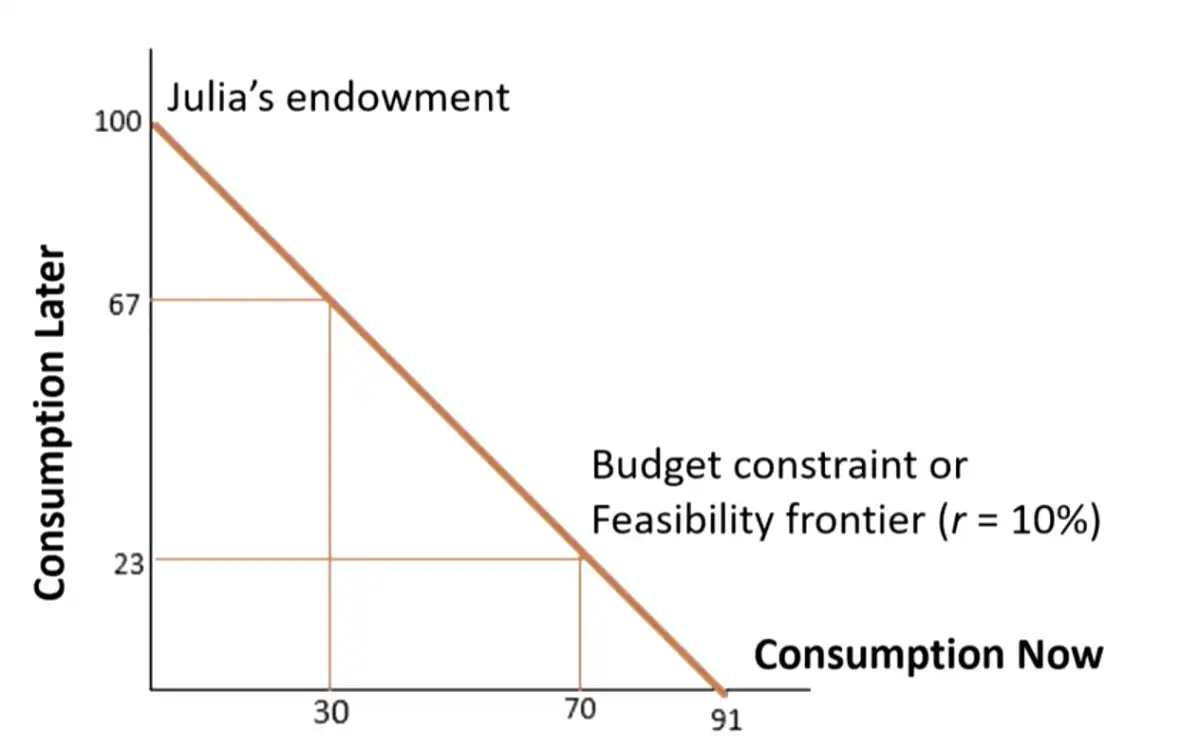 Note the intercepts (100 later and 91 now)
- But if the interest rate were 80%