Lecture 32 Hedonic Editing Hypothesis
Sairam
The Framing of Gains & Losses
- Lecture 26__The Value Function#
- KT's Value function
- \(v(\cdot)\) defined over perceived gains and losses relative to some natural reference point
- \(v(\cdot)\) assumed to be concave for gains, and convex for losses.
- \(v''(x)\lt 0\) when \(x \gt 0\) (gains), has a maxima
- \(v''(x)\gt 0\) when \(x \lt 0\) (losses), has a minima
- Loss function is steeper than the gain function
- \(v(x) \lt -v(-x)\) for \(x\gt 0\) (gains)
The value of gains is perceived smaller in absolute terms (-ve sign) than the same amount of loss.
- \(v(x) \lt -v(-x)\) for \(x\gt 0\) (gains)
Decision Frames
- Three ways of framing outcomes
- Minimal account
- Focus remains on the necessary concept: "Am I willing to drive 20 minutes to save $5?". In this situation, he would be indifferent to either situations.
- Focus only on the differences, not on the common features.
- Topical account
- Relates consequences of the choices to a reference level
- This ref level is determined by context
- e.g. Mental Accounting
- Comprehensive account
- Accounts for all factors
- Current wealth, future earnings, possibility of other holdings etc.
- Econ Theory assumes people use comprehensive account
- Minimal account
-
Jacket & Calculator Example
- Let existing wealth be \(W\)
- Let \(W^* =W +\text{Jacket + Calculator} - \$140\)
- Then the choice is between
- utility of \(W^* + \$\)
- \(W^* + \text{20 mins}\)
The way a decision is framed will not alter choices if using a comprehensive wealth-based analysis.
- But framing does alter choices in the real world, people take decisions piecemeal, influenced by context of choice
Coding Gains & Losses
- Value function defined over unidimensional outcomes
- What about joint outcomes \((x,y)\)? Two possibilities
- Value them jointly, integrated outcomes \(v(x+y)\)
- Value them separately, segregated outcomes \(v(x) + vx(y)\)
- Now, which one between these two produces greater utility?
- Why is this issue interesting?
- If given the choice to code, they would frame outcomes in whatever makes them happiest
- They have preferences of life organization, would they rather have salary + bonus or a salary equivalent amount?
- (Marketing) how would the seller frame the characteristics of the transactions. Which to combine, which to separate?
Hedonic Framing
- Jacket & Calculator problem demos that MA is piecemeal & topical.
- We are more willing to save money on a small purchase than a large one.
- Disparity \(\implies\) \(v(-125) - v(-120) \neq v(-15) - v(-10)\)
- Now, how to combine two or more financial outcomes?
4 experiments & Theory they developed
- Segregation
. + .- Integration
.
- Mr. A : $50 in one, $25 in another
- Mr. B single, larger World Series lottery: $75
- \(A \gt B\), happier
- Multiple gains: Segregation is preferred. \(v(x) + v(y) \gt v(x+y)\) (concave value function)
Frequency tells you are lucky
- Mr. A: $100 tax return, $50 state tax return, arithmetical mistake
- Mr. B: Owed $150… no other repercussions in either case
- \(A \gt B\) Upset… "Just hit once bro"
- Multiple losses: Integration is preferred.
\(v(-x) + v(-y) \gt v(-(x+y))\) (concave)Frequency tells you are unlucky
- Mr. A won $100 in lottery and had to pay $80 to the landlord for an accident for the damaged rug.
- Mr. B first lottery ticket… won $20.
- \(B \gt A\), happier
- Mixed Gain: Integration is preferred
\(v(x) + v(-y) \lt 0\) while \(v(x-y)\gt 0\) when \(x \gt y\) (loss function is steeper) - Integration leads to cancellation**
- Mr. A's car damaged \(\to\) $200 to repair…He won $25 in the office football pool.
- Mr. B's car damaged \(\to\) $175 to repair.
- \(B \gt A\), upset
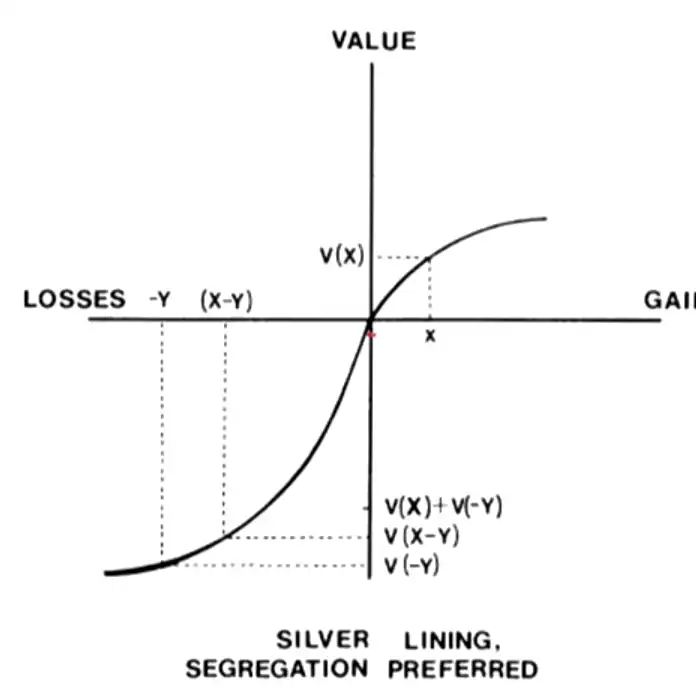
- Mixed Loss: Segregation is preferred
- Silver Lining principle
Mixed Losses (close vs large gap)
- When \(X\) and \(Y\) are relatively close, integration is preferred
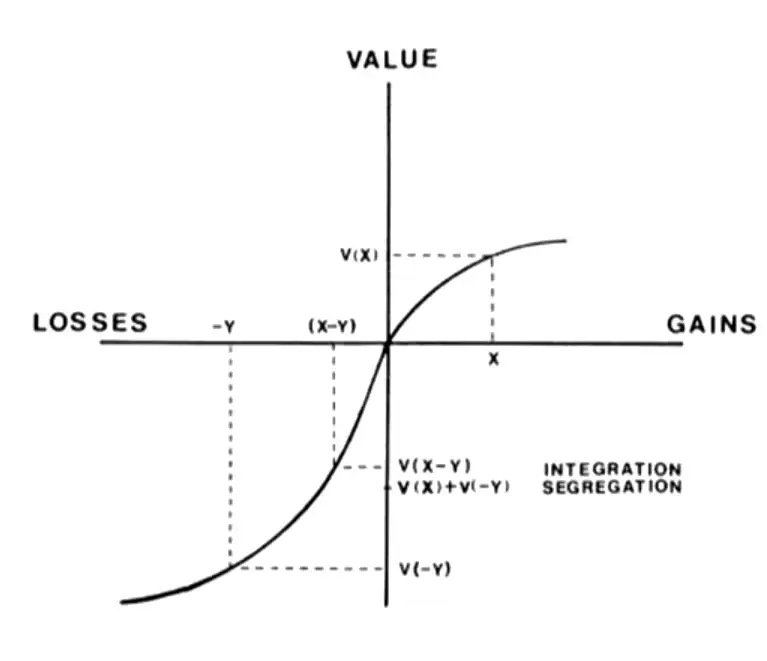
- When \(Y \gg X\), segregation is preferred (SILVER LINING EFFECT) \((-200 + 25)\)
Hedonic Framing
- Principles of hedonic framing, give us a way of evaluating joint outcomes
- Segregate gains (concave)
- Integrate losses (convex)
- Integrate smaller losses with larger gains (to offset loss aversion) \(\to\) Cancellation
- Segregate small gains (silver lining) from larger losses (gain function is steepest at origin, utility of a small gain \(\gg\) utility of slightly reducing a large loss)