Endogenous Growth Models
Learning-By-Doing (The Arrow Model)
- Endogenous Growth models: Learning - By- Doing (The Arrow Model):
- Kenneth Arrow used the concept of learning-by-Doing (when a worker's productivity increases through Practice) to refer to skills acquired by hands-on work and not certified by the formal system of education.
- Arrow used this concept to explain the effects of innovation and technological change on output and Productivity.
- The eco. implications of "L-b-D": In his classical paper Published in 1962, he demonstrated that the increase in PCY can't be entirely explained by increase in K/L ratio.
- He isolated the rate of technological change in economic growth by incorporating a separate term for knowledge in the Production Function and showed that how this contributes to the highest share of Overall productivity increase.
- Arrow's research showed that differences in technology and Available labor significantly affect how fast a Country grows economically. He made govt. recognize that investing in education and R&D is vital for long-term growth.
Learning, Diminishing Returns, and Technological Progress
- Arrow Observed that learning takes place by an attempt to solve a problem. Here, it takes place Only during an activity.
- However, Arrow observed that learning with repetitive activities always yields diminishing returns.
- Therefore, to have a steadily increasing performance, the challenges or tasks must evolve. They must become Complex or different, not just repeat.
- Arrow also emphasized the role of experience in increasing productivity. As individuals produce goods, ways of improving Production processes happen inevitably.
- The improvement in production as a by-product of normal production activity and not as a result of deliberate efforts.
- Therefore, L-b-D can be recognized as the source of technological progress.
- It is not merely The share of GDP allocated to R&D that drives Knowledge accumulation, but more crucially the extent to which new knowledge is indigenously created Through ongoing production activities in the economy.
The Production Function and Endogenous Knowledge
- The production function, depending on the Technology accumulation will have the form of:
\[Y_{t}=K_{t}^{\alpha}(A_{t}L_{t})^{1-\alpha}\]
- \(K\) capital, \(L\) Labor, \(Y\) output, \(A\) Stock of Knowledge and \(\alpha\) is a parameter lies bet 0 to 1.
- The simplest case of L-b-D is found in those situations where learning occurs as a consequence of the Production of new capital.
- Since increase in Knowledge = f(increasing capital) \(\rightarrow\) Stock of knowledge \(\propto\) f(stock of Capital).
- As Capital is endogenous here, which grows through Savings and investment decisions, Since Knowledge is a function of stock of capital, via this knowledge also becomes endogenous.
\[A_{t}=BK_{t}^{\beta}\]
where \(\beta\) and \(B\) are positive.
\[Y_{t}=K_{t}^{\alpha}B^{1-\alpha}K_{t}^{\beta(1-\alpha)}L_{t}^{1-\alpha}.\]
- where
- \(K_{t}^{\alpha}\) has direct contribution to output.
- \(K_{t}^{\beta(1-\alpha)}\) has indirect Contribution. This is the additional benefit of capital through its role in generating knowledge.
- Final Production function is \(Y_{i}=A(K)F(K_{i},L_{i})\). It captures how an individual firm's output depends not just on its inputs but also economy wide capital stock, which enhances productivity Through L-b-D. Overall capital in economy will spillover.
The Romer model: Learning by Investment
- Romer in his paper on endogenous growth Published in 1986 Presented a variant of Arrow's Model naming it as "learning by investment".
- He considered knowledge as an input in the Production Function indicating:
\[Y_{i}=A(R)F(K_{i},L_{i})\]
- Agg. Output \(A(R)\) - Public stock of knowledge from R&D
- \(R_{i}\) - stock of returns from expenditure on R&D by firm (\(i\))
- \(K_{i}\) - Capital stock of firm(\(i\)), \(L_{i}\) - Labor input of firm (\(i\))
- Romer Considered the 3 key elements in his model:
- Positive externalities
- Increasing returns in the Production function of output
- Diminishing returns in the production of new knowledge
Knowledge as the spillover effect from R&D efforts or investment by a firm.
- The effect of new research and technology acquisition by a firm was assumed to spill-over across the entire economy.
- Therefore, in this model, new Knowledge is considered the key determinant of long-run growth which is determined by investment in research and new technology.
- Romer separates the economy into 2 sectors:
- Goods sector: Uses capital and labor to produce output (Y).
- Research Sector: Uses labor and knowledge to produce a new Knowledge.
Returns, Externalities, and Monopoly Power
- The implication of R&D exhibiting diminishing returns meant that investment in R&D will not therefore Continue to yield proportionate increase in Knowledge, thereby limited returns.
- However, Other firms also benefit from new technology due to factor like inadequacy of Patent Protection.
- In a Competitive equilibrium: firms act independently, aiming to max profit in a Competitive market.
- This will result in positive externalities where one firm's innovation benefits other firms.
- This leads to higher aggregate economy-wide returns. So, Romer's model explains how knowledge accumulation by profit - maxing firms, though it may yield limited returns at the individual level, creates Positive externalities That result in increasing returns to the entire economy.
The AK Model of Growth
- O. Sergio Rebelo (1991) introduced the AK Model building upon The earlier work by Romer, the Ak model was simply expressed as Y = AK where \(A\) - Technology, \(K\) - Physical and Human Capital.
- In this model there are no diminishing returns bcoz, the MPK is never negative.
- Capital is assumed to have accumulated by some portion of aggregate output saved by individuals.
- Capital accumulation (\(\dot{K}\)) is:
\[\dot{K} = sY - \delta K\]
- Here, Capital will continue to grow since investment in this model is greater than depreciation.
- This is bcoz
- \(sY\) and \(\delta K\) are both linearly upward sloping lines.
- Saving \(sY\) is a Constant function of \(Y\)
- \(Y\) is linear in \(K\).
So, dividing both sides by \(K\):
\[\frac{\dot{K}}{K} = \frac{sY}{K} - \delta\]
and since \(Y = AK\)
\[\frac{\dot{K}}{K} = \frac{sAK}{K} - \delta\]
\[\frac{\dot{K}}{K} = sA - \delta\]
Here \(A\) is constant at this stage (\(A\) is fixed and growth comes from capital accumulation)
Taking \(\ln\) to growth equation,
\[
\ln Y = \ln A + \ln K
\]
Differentiating w.r.t time,
\[\dfrac{\dot{Y}}{Y} = \dfrac{\dot{K}}{K}\]
Using this in \(\dfrac{\dot{K}}{K} = sA - \delta\):
\[\dfrac{\dot{Y}}{Y} = sA - \delta\]
\(\therefore\) Growth rate of output is an increasing function of the rate of investment (\(sA\)).
AK Model Growth Rate and Ideas as the Engine
- We understood from the Solow model, that it is the technology that causes the investment in the capital which causes the actual growth.
- Without technological change, growth would stop.
- Therefore, one must Consider technology as a key driver to EG (Endogenous Growth).
How this technology grows in any economy?
- It is the generation of new ideas, and the ideas themselves improve the technology of Production.
- Romer in 1986, 1990 Papers modelled ideas as an engine of growth.
- Romer's basic argument was that idea, as a good, was non-rivalrous in nature.
- This made Romer suggest that this implies Increasing Returns to Scale (IRS).
- If IRS to be present in a competitive environment we need an explicit representation of its research.
- This also introduces the element of imperfect Competition.
- The non-rivalrous goods need to be produced only once. Such goods have a fixed cost of production and Zero Marginal Cost (MC).
- It takes a lot of effort to bring out the first unit of software, but subsequent copies are produced by just Copying from the first unit.
- Nature of costs involving non-rivalrous goods suggest the presence of IRS and imperfect competition.
- Why Non-rivalry leads to IRS?
- One time fixed cost to develop the idea (software).
- Very low or zero MC to make additional copies (download).
- Doubling input more than double the output (Since the idea is reusable).
- This implies IRS.
Imperfect Competition and Patents/Copyrights
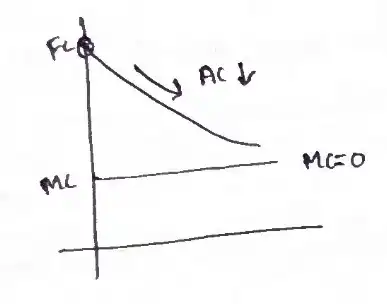
- Under perfect competition, Firms charge Price = MC.
- But here MC is 0.
- If they price at \(MC = 0\), they can't recover The costs \(\pi = (P - AC)Y\).
- With IRS \(AC > MC\).
- When the producers get the power of patents and Copyrights they get monopoly powers for some time allowing them to reap profit from their ideas.
Robert Lucas and Human Capital
- Robert Lucas utilized a model of endogenous growth developed by Uzawa.
- Uzawa developed an endogenous growth model based on investment in Human Capital (HC).
- Lucas also drew from the Theory of Human capital by Gary Becker.
- Lucas assumed that investment on education leads to the production of human capital which is the crucial determinant in the growth process.
- He classified this as:
- Internal effects of HC where the individual worker undergoing training becomes more productive.
- External effects: which spillover and increases the Productivity of capital and of other workers in the economy.
- It is the investment in HC rather than PC that have Spillover effects that increase the level of technology.
- Output for firm(\(i\)) takes the form:
\[Y_{i}=AK_{i}(H_{i})(\bar{H}^{e})\]
- \(A\) - Technology coefficient.
Lucas Model: HC Dynamics and Returns to Scale
- \(K_{i}\) and \(H_{i}\) are the inputs of PC and HC used by firm (\(i\)), Produce output (\(Y_{i}\)).
- \(\bar{H}\) is the economy's average level of HC.
- \(e\) is the parameter that represents strength of the external effect from the \(\bar{H}\) to each firm's productivity.
- In the Lucas model, each firm faces constant returns to scale (CRS).
- While there are Increasing Returns to Scale (IRS) for the whole economy.
- Lucas assumed HC accumulation (\(\dot{H}\)) as:
\[\dot{H} = \frac{dH}{dt} = \gamma(1-u)H\]
- where
- \(u\): Time spent working.
- \(\frac{\dot{H}}{H} = \gamma(1-u)\) where \((1-u)\) is the time spent accumulating skill.
- HC doesn't grow automatically; it increases when people spend time learning or training.
- If individuals spend more time learning, \(u\) is smaller, then \((1-u)\) is larger, leading to \(\dot{H}\) increasing the rate of Growth of HC.